Thursday, December 24, 2009
Some Reflections on College Radio at the End of the Decade
Over on Radio Survivor, a group blog that I write for, we're counting down the top radio trends of the past decade. The first two trends that I've reported on both have to do with some gloom and doom stories about college radio.
Yesterday I wrote about college radio tightening its playlist and today I discussed the disturbing trend of universities turning their backs on college radio.
Although it bums me out to read about college radio losing funding, getting shut down, and being overtaken by public radio content; I remain eternally optimistic about the future.
It's my mission to give more attention to independent radio and to remind EVERYONE about its ongoing relevance. So, in 2010 I'll still be doing my best keep college radio alive.
Our trend stories will continue next week and many of the pieces will have implications for college radio. I encourage you to take a look and share your thoughts about the past and future of radio and let us know if there are big stories and radio trends that we missed.
Yesterday I wrote about college radio tightening its playlist and today I discussed the disturbing trend of universities turning their backs on college radio.
Although it bums me out to read about college radio losing funding, getting shut down, and being overtaken by public radio content; I remain eternally optimistic about the future.
It's my mission to give more attention to independent radio and to remind EVERYONE about its ongoing relevance. So, in 2010 I'll still be doing my best keep college radio alive.
Our trend stories will continue next week and many of the pieces will have implications for college radio. I encourage you to take a look and share your thoughts about the past and future of radio and let us know if there are big stories and radio trends that we missed.
Tuesday, December 22, 2009
WRVU Reduces Number of Non-Student DJs
Well, I just got word that Vanderbilt University station WRVU is another college radio station that has recently decided to limit the number of community DJs on their airwaves. According to an article in the Tennessean last week,
On The Nashville Scene blog there's a list of the shows being eliminated and saved at WRVU.
This is quite similar to the new policy implemented at WITR (which by the way has inspired its own protest group on Facebook). As others have pointed out, it will be interesting to see if there are enough students willing to fill the open shifts.
Although it's important to make room for student DJs, I know that most stations struggle to get enough DJs to fill all of the open shifts. The growing trend is to air automated programming when shifts aren't covered. Hopefully these stations will still keep an open mind about utilizing community members for difficult to fill shifts.
"The Vanderbilt Student Communications board voted in November to limit the number of disc jockeys on the station who are not directly affiliated with the university, cutting the number from roughly 50 to 25. Over the past week, many of them have signed off. Chris Carroll, director of student media, said the cap was necessary because there were too many 'community' DJs on the airwaves, and managing all of them had gotten difficult for the station's student staff. 'There was a loose belief that anyone who had an interest in radio had an opportunity to come have a show,' he said. 'That was not what was ever intended.'"
On The Nashville Scene blog there's a list of the shows being eliminated and saved at WRVU.
This is quite similar to the new policy implemented at WITR (which by the way has inspired its own protest group on Facebook). As others have pointed out, it will be interesting to see if there are enough students willing to fill the open shifts.
Although it's important to make room for student DJs, I know that most stations struggle to get enough DJs to fill all of the open shifts. The growing trend is to air automated programming when shifts aren't covered. Hopefully these stations will still keep an open mind about utilizing community members for difficult to fill shifts.
Monday, December 21, 2009
WITR Reduces Community DJ Shifts to Make Room for Student DJs
Here's a story that's sure to stir up some debate. According to an article in today's Democrat and Chronicle, Rochester Institute of Technology's student radio station WITR has made the decision to reduce the percentage of airtime devoted to shows hosted by community DJs in order to make more room in the schedule for students. The article states:
According to an article earlier this month, long-running shows at the station included a reggae show that's been on the air for 30+ years, a gospel show with a 28 year tenure, and a 25-year-old garage rock show.
As a result of changes in the schedule, some community DJs have already given up their shows. Some long-time listeners and former DJs are publicly venting about this and have expressed concern that this schedule change is part of a larger mission to standardize the station and make it more like a commercial station.
Yet current staff members argue that this is not the case, that they are just making a few tweaks to programming requirements. One DJ pointed out in a comment on the WITR Facebook page, "There are non college members that are taking away opportunities from college students on a college station."
However, some listeners point out that this focus on current student needs may not be the best idea. One commenter on today's story argued,
Another listener writes, "There are certainly more community members compared to RIT students that listen to WITR. The community DJs bring a wealth of experience and contribute great programming." And, this comment may get to the core of what WITR is hoping to change. By reducing the amount of time devoted to long-time specialty programming (which is probably favored by older listeners) and tightening up their indie rock playlist they may be hoping to attract more college student listeners.
Every college station has different guidelines concerning non-student DJs. Some stations only allow students to be on the air, whereas others have an unlimited number of community DJs. Some say that community DJs are the glue that holds together a college station, since students come and go and don't always keep an eye on station tradition. Yet others argue that long-time community DJs can make for a more stagnant airsound. For that reason, many stations require that all DJs reapply for their shifts every semester; so that the programming department can re-evaluate all of the shows and make room for new DJs.
Every station has its own mission and priorities as far as programming goes; so there's certainly no right answer on this one.
How does your station incorporate non-student DJs into the schedule? Has this ever been a source of controversy?
By the way, here's an amazing gem from WITR's past: some 1968 film footage of the student radio station!
"The campus radio station at Rochester Institute of Technology will be cutting back, but not eliminating, programming hosted by non-students. That's the final decision of the student Executive Board of WITR-FM (89.7) after a month-long debate over community programming that had escalated after the sudden resignation of Colin Thomas, who had hosted the Saturday afternoon Reggae Sounds, which the station said was the longest-running reggae show in the country.
Student managers did not return several phone calls asking for comment over the past two weeks, but the community disc jockeys say the biggest failure during this debate was a lack of communication from the students. The bottom line, according to a memo issued by the station, is that community slots will be limited to two hours starting in January. Six shows that the station's programmers deemed unnecessary, including three dedicated to Christian rock, have been eliminated. The goal, according to the board memo and the community DJs, is to create more on-air slots for student DJs."
According to an article earlier this month, long-running shows at the station included a reggae show that's been on the air for 30+ years, a gospel show with a 28 year tenure, and a 25-year-old garage rock show.
As a result of changes in the schedule, some community DJs have already given up their shows. Some long-time listeners and former DJs are publicly venting about this and have expressed concern that this schedule change is part of a larger mission to standardize the station and make it more like a commercial station.
Yet current staff members argue that this is not the case, that they are just making a few tweaks to programming requirements. One DJ pointed out in a comment on the WITR Facebook page, "There are non college members that are taking away opportunities from college students on a college station."
However, some listeners point out that this focus on current student needs may not be the best idea. One commenter on today's story argued,
"This is an extremely short-sighted move for WITR. Just look at the number of years these shows have been running: 10 years, 25 years...How long does a student's college stay last...maybe 5 years at most. And how long will this sudden wave of radio interest last...maybe one semester."
Another listener writes, "There are certainly more community members compared to RIT students that listen to WITR. The community DJs bring a wealth of experience and contribute great programming." And, this comment may get to the core of what WITR is hoping to change. By reducing the amount of time devoted to long-time specialty programming (which is probably favored by older listeners) and tightening up their indie rock playlist they may be hoping to attract more college student listeners.
Every college station has different guidelines concerning non-student DJs. Some stations only allow students to be on the air, whereas others have an unlimited number of community DJs. Some say that community DJs are the glue that holds together a college station, since students come and go and don't always keep an eye on station tradition. Yet others argue that long-time community DJs can make for a more stagnant airsound. For that reason, many stations require that all DJs reapply for their shifts every semester; so that the programming department can re-evaluate all of the shows and make room for new DJs.
Every station has its own mission and priorities as far as programming goes; so there's certainly no right answer on this one.
How does your station incorporate non-student DJs into the schedule? Has this ever been a source of controversy?
By the way, here's an amazing gem from WITR's past: some 1968 film footage of the student radio station!
WWRM's Renaissance at Randolph College
In spite of all of the gloom and doom stories about radio these days, my optimism for college radio remains strong. This week's Lynchburg News Advance story about Randolph College station WWRM is a nice reminder that college radio perseveres. Like many stations, WWRM (aka "The Worm") has been through its highs and lows over the years, but seems to be on an upswing. According to the article:
According to WWRM's website, the online-only station originally broadcast over AM carrier-current, then through cable TV at Randolph-Macon Woman's College. The complete history of the station is a bit of a mystery, although it looks like campus radio dates back to at least the 1950s. A 1950s station with the call letters WAVA was based at the college, but, somewhere around 1957 the call letters and some equipment was sold off, perhaps evolving into WWRM."Shows on the censorship-free station run the gamut from indie rock and zombie music to sports talk and poetry readings. Students can talk about whatever they want, as long as they do not slander members of the Randolph College community. And any music is fine, as long as it’s not pirated...
This fall, WWRM experienced a renaissance, growing from a handful of inconsistent shows to 47 deejays putting on 28 live shows a week...
'Radio definitely is a dying art, but I think that’s part of the appeal maybe on this campus,' [student manager Sarah] Kreiger said...
The studio dates back to when the station was founded in the 1960s. The musty brown rug and a collection of about 2,000 vinyl records have survived the decades..."
Monday, December 14, 2009
KFJC's 50th Anniversary Bash this Friday in San Francisco

It's been a fun year at Foothill College (Los Altos Hills) radio station KFJC, as we've been reminiscing about our 50 years on the air all year. The grand finale of all of the celebratory activities will be a big party at Cafe du Nord in San Francisco this Friday, December 18th starting at 7pm.
The free, all ages event will include a bunch of live bands, including Pink Canoes, T.I.T.S, Seven Lies about Girls, and Al Qaeda (who are nicely profiled in this piece about the KFJC bash in the SF Weekly).
Lots of KFJC DJs and alumni are expected to be in attendance and no doubt there will be opportunities to pick up KFJC T-shirts, CDs, and miscellaneous paraphernalia. More details can be found on the KFJC website.
Friday, December 11, 2009
Radio Station Field Trip 20 - WGBK's Glenbrook South Radio
A few weeks ago I was driving around near Chicago, scanning the dial for interesting non-commercial radio stations when I suddenly became riveted by what I was hearing. The voices were young and it seemed clear to me that it must be a high school station.
As I continued to listen, I heard a public service announcement about depression, an ad for a high school newspaper, references to a recent loss by the girls volleyball team, a restaurant review for McDonald's, an investigative piece about a new trash pickup system, and a series of technical snafus and dead air. In terms of the music, it ranged from metal to Bob Marley to Tom Petty.
I was charmed and made it my mission to learn more about the station.
As it turned out, the station that I was listening to, WGBK, was indeed a high school station located in the suburbs of Chicago near where I was staying with family. The Saturday morning programming that I was treated to was produced by students at Glenbrook South High School in Glenview, Illinois. I later learned that Saturday mornings are reserved for DJ trainees; so the on-air struggles and dead air that I heard could be attributed to that.
WGBK broadcasts in the Chicago suburbs over 88.5 FM. Their FM programming is split between two high school stations: Glenbrook North and Glenbrook South; with each school handling programming on different days of the week. Each station also has their own separate webstream.
The school district purchased the station in 1997 from a Christian day school (Midwestern Academy) which had run the previous station under the call letters WMWA. In the period prior to the sale, WMWA offered the district air time and this began with broadcasts of sporting events and evening programs by radio students at Glenbrook South beginning in the 1980s.
Thanks so much to the students and staff of WGBK for welcoming me to their station on the afternoon of November 16, 2009. I sat down with station adviser/broadcasting teacher Dan Oswald (known to his students as "Doc") to talk about the radio program at Glenbrook South, with which he has quite a history. Dan was actually a student at Glenbrook South from 1988 to 1992, starting his "radio career at 13." He has been in charge of the station as a faculty member since 2004. Dan told me, "it's nice to come back to a program that I got a lot out of." During his tenure as a faculty member he's been able to take the station online and 24/7.
This was my first visit to a high school radio station and I was both jealous and impressed, since I didn't have the opportunity to do radio at my high school. Glenbrook South is a large suburban high school on Chicago's north shore with gorgeous facilities. They have a broadcasting department, with a number of radio classes available for students. Between 130 and 140 students participate in radio classes and/or work at the station. Right now the majority of those kids are boys, with girls making up only about 10% of radio participants. Dan said that he's been working on increasing partcipation by girls, saying, "I would like more young ladies to take radio."
The Glenbrook South station, which broadcasts over FM on Mondays, Wednesdays, every other Friday, and on Saturdays is programmed like an "alternative rock station" with a "college radio feel," according to the station's adviser Dan Oswald. Like many college stations, they report their charts to CMJ.
Generally the station is live on the air in the afternoon and evening, from 3:30 until 10 or 11pm. They can be on the air as long as they like on their scheduled days, with the one stipulation being that an adult supervisor must be present. Many retired radio teachers from the program stick around as supervisors, including Mr. Weiss, who I met on my visit.
When they don't have live DJs they broadcast automated programming. On Tuesdays, Thursdays, and alternate Fridays the broadcast transitions to the station at Glenbrook North High School beginning at 6am. Each high school has their own studios, but they share a frequency. Dan said, "we're one station...our programming complements one another." He noted that the station is a "window" into the school community since it airs both schools' sporting events, a range of music, documentaries and public service announcements.
Glenbrook South's station is the result of a rigorous radio program, which Doc says he teachers like a college course. All advanced radio students also have jobs at the station, much like one would in college radio. They have been recognized with numerous radio awards and according to Doc, the station has won numerous John Drury High School Radio Awards.
Their online stream (facilitated through Live 365) has seen listeners from Ireland, Canada, Argentina, and Belgium. Alums from the program include not only the station adviser, but also Fall Out Boy's Patrick Stump and the young music journalist behind MissExclusive.
DJs at the Glenbrook South station do still play CDs and vinyl, but mostly use mp3s. I was very impressed to see that they do maintain a vinyl library and the students who toured me through it noted with pride that they value the station's history and music collection. The Radio Club began at Glenbrook South in 1981, so there is some music dating back to the 1980s in their library. Additionally, when the station was purchased from WMWA they also aquired that station's music.
I talked with a few of the student DJs, including Alex (one of the station managers) about their take on the future of radio. Alex said, "when I do my show...I like to do radio the way....I would want to hear it...playing more music....less talk....[for a] classic radio vibe." He also admitted, "I still like to listen to my iPod," saying that he does more iPod listening than radio listening.
New Music Director Blake said, "I had no idea that radio was dying at the time that I joined [the station]," but isn't particularly focused on the "movement to change that" either. Like Alex, he told me that he wanted to do radio that represents what he'd like to hear, including a "balance of talk...music...and news."
It was clear from my visit that WGBK was a special place and that the students in the program had a great deal of respect for their adviser and pride in the work of their station. It brought back memories for me of my experience on my high school newspaper, as we also had an inspirational adviser with high expectations. That combination can be magical and I was happy to see students who had this opportunity to do radio.
According to Doc, many graduates of WGBK go on to work in college radio; and the DJs who I spoke with also expressed interested in continuing their work in both radio and music production.
Thanks again to everyone at WGBK for showing me that radio is alive and well on at least one high school campus.
Previous Spinning Indie Radio Station Field Trips:
Field Trip to WECB at Emerson College
College Radio Field Trip 2 - Cal Poly's KCPR
College Radio Field Trip 3 - Notre Dame's WVFI
Radio Station Field Trip 4 - WFMU in Jersey City
Radio Station Field Trip 5 - East Village Radio in NYC
Radio Station Field Trip 6 - WNYU in New York City
Radio Station Field Trip 7 - Northwestern's WNUR
Radio Station Field Trip 8 - Stanford's KZSU
Radio Station Field Trip 9 - University of San Francisco's KUSF
Radio Station Field Trip 10 - Santa Clara University Station KSCU
Radio Station Field Trip 11 - UC Berkeley's KALX
Radio Station Field Trip 12 - KSJS at San Jose State University
Radio Station Field Trip 13 - WBAR at Barnard College
Radio Station Field Trip 14 - KFJC at Foothill College
Radio Station Field Trip 15 - UC Santa Cruz Station KZSC
Radio Station Field Trip 16 - Haverford College Station WHRC
Radio Station Field Trip 17 - FCCFree Radio in San Francisco
Radio Station Field Trip 18 - Flirt FM in Galway, Ireland
Radio Station Field Trip 19- WRXP 101.9 in New York City
Thursday, December 10, 2009
Spinning Indie 50 State Tour: Stop 13- Nebraska's KRNU

There's been a burst of energy on the Spinning Indie 50 State Tour, as I've begun pestering some of the stations who have been on my interview wish list for awhile. As you might recall, I'm making my way through all 50 states in order to highlight some of the amazing radio stations that might not be familiar to people who live in other parts of the country.
This virtual tour of radio stations has so far included stops in 12 states, including Arkansas, Wisconsin, Kansas, Louisiana, Alaska, North Dakota, Nevada, West Virginia, Kentucky, Minnesota, Montana and California.
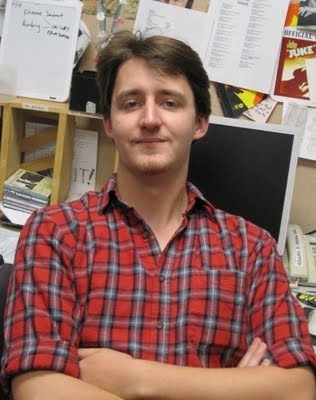
Next up, I'm happy to share with you a virtual trip to Nebraska, to learn more about University of Nebraska (Lincoln) station KRNU. Thanks so much to KRNU Music Director Casey Welsch for taking the time to answer some questions over email. You might remember that I recently posted a piece about a column that Casey wrote for his campus paper about his favorite college radio stations.
Radio history goes as far back as 1922 at University of Nebraska, with various radio experiments and stations along the way. KRNU has been in existence since 1970 and will be celebrating its 40th anniversary next year. The current alternative music format has been a staple of the station for 20 years, as it began in 1989.
I was very interested to learn more about the current state of things at KRNU as they went through some programming changes and added a web channel in August 2009. According to an August 2009 press release quoting General Manager Rick Alloway,
"'This fine-tuning of the 90.3 KRNU format will create a modernized training experience for students while focusing more attention on the alternative/indie music interests of the 18-24 year-old listening audience. At the same time, the creation of the second web channel will allow the continuation of the innovative and eclectic programming the college has always produced.'"
With this shift in programming, many specialty shows, sports and talk were moved to a web channel known as Studio 201. The main station, KRNU, is now a more tightly formatted indie station.
In his interview with me, Music Director Casey Welsch explains the changes at KRNU and talks about the station's role in the broader music community of Lincoln, Nebraska.
Spinning Indie: What motivated you to get involved with college radio?
Casey Welsch: I started working at KRNU one month after I arrived at UNL. I was a music snob and kind of a no-it-all about all things music, and I had always liked the station whenever I heard it going through Lincoln, so I jumped right on. I've been here over two years now and started working as a music director last May. I've been loving the job ever since.
Spinning Indie: How is college radio in 2009 different from when you first began at KRNU?
Casey: In general, there is a lot more research to be done on the internet. It seems that all the big tastemakers right now are music blogs and such. We still try to play more than what the blogs recommend, since internet music often sounds the same as everything else and is driven by hype, but we monitor the net a lot more now.
For KRNU specifically, we split into two separate playlists just this summer. A tighter, more unified playlist now dominates KRNU, and a more twitchy, experimental, freeform playlist is now on our web station, Studio 201. That's made music directing a lot tougher, but it gives us a wider medium to play music on as well.
Spinning Indie: It's amazing that radio dates back to 1922 at University of Nebraska. Can you tell me a bit about the history of KRNU?
Casey: KRNU has gone through a lot of changes and moved around quite a bit over its history. In the beginning, it was just news and classical music for most of the day, and didn't broadcast 24/7. As it got older and older, the music started to change with the changing times, and it eventually became a pop station. It has always carried Cornhusker sports, though.
The current format started in 1989 and it has been an indie/alternative station ever since. We now broadcast 24/7 over the air and with two channels on the web at krnu.unl.edu. KRNU has been in its current studio since 2001 when the college of Journalism and Mass Communications moved to its new current building.
Spinning Indie: Do you have any music or artifacts from the early years of the station? Tell me about what you have and if DJs continue to play any of the old records.
Casey: There are actually hundreds of old TV, Radio and Newspaper artifacts on display all over our college. Our former dean was a huge collector of old journalism paraphernalia, and he donated his entire collection to the college when it moved to its current location, and old federal building. There are simply too many pieces to describe, it's like a museum.
Spinning Indie: Explain the new station format and how it's different from prior years.
Casey: KRNU has gone a bit more chart-conscious with its music in an effort to attract new listeners. This is a new development and we are yet unsure how well it's working. KRNU as it used to be is now online only and was renamed Studio 201 (the room it broadcasts out of). There are more people in the crew that manages KRNU, as we have become a bigger operation, so it can get a bit crowded as far as management goes, but it still runs smoothly.
Spinning Indie: Why did the overall programming philosophy change and what kind of response are you getting to the new format?
Casey: The programming changed at the request of the University, who wanted to see the station bring in more money. They hired a group of radio consultants who came in and kind of made us make the station a bit more mainstream. There was initially a huge public outcry against what we were doing with the station, and many of us here did not like what was happening at all. We have wrestled control back from the consultants now, however, and are trying to stay true to our incredibly devoted audience here in Lincoln. More changes are to come. We're still evolving.
Spinning Indie: Are there any specific rules about the music that gets added to your station? Are DJs required to play anything in particular? Is there anything they aren't allowed to play?
Casey: The one rule about music on KRNU is that it has to be GOOD. It has to be truly good. We don't care how well something is charting or how much blog buzz it has, because if it sucks, we aren't playing it. Admittedly, we have had to be a bit more chart-conscious as of late, but we try to have foresight and pick out the artists who we know are only going to chart for a week or so on buzz alone. We pay them no mind.
DJ Kate in one of KRNU's 4 production studios (note the reel-to-reel behind her!)Photo Courtesy of KRNU
Spinning Indie: Do you add MP3s? vinyl? cassettes? What format of music gets played the most?
Casey: We use a very old system to automate our station that requires uploading everything directly from CD format. KRNU has made the switch to all .WAV files for our music, and Studio 201 still uses mostly CDs.
Spinning Indie: What's the music scene like in Lincoln and what role does KRNU play?
Casey: Lincoln is a small city that has a music scene the size of a much bigger one. There are so many great bands in Lincoln that span all genres. Some of the most popular acts in Lincoln include a soul singer called Son of 76, a hard psych/krautrock band called Gold Lions, a one-man freakshow called The Show is the Rainbow and an accoustic Bluegrass band called Triggertown.
And of course there's UUVVWWZ and Eagle Seagull. We're very proud of how well they both have been doing. As for KRNU's role in the community, we have a very good local show called Lost & Found that has been going for several years now. The hosts like to have lots of live performances on the show and they do a great job of getting new music to the people of Lincoln.
Spinning Indie: What's the longest running show/DJ at the station?
Casey: Our longest running show is actually our metal show Heresy. It has been on the air since 1989 and has changed with every new movement in metal. When it started it was a hair/glam show and is currently a loud rock/death/grind show. It has seen more hosts come and go than anything else on the air.
Spinning Indie: Are the majority of your DJs students? What's the role of community DJs at the station?
Casey: All of the DJs on KRNU are students. It is a policy of ours. Any UNL student can be a DJ and any CoJMC [College of Journalism and Mass Communications] student can have a specialty show. No one can be on the station without being currently enrolled. There are actually classes at CoJMC that require a shift on KRNU, so we like to keep it student-exclusive.
Spinning Indie: What specific specialty shows are you airing on KRNU and on Studio 201?
Casey: They vary. One of the changes on KRNU was that we took all of the sports and talk shows and stuck them on Studio 201. On KRNU right now we have two hip-hop shows, two electronic shows, a metal show, an industrial show, the local show, an alt country/folk show and a funk/soul show that I have been hosting for over a year now. On Studio 201 we have a ska/reggae show, two sports shows and a general talk show, as well as hourly news updates and bi-hourly sports updates that are engineered by students in broadcast news classes.
Spinning Indie: Do you listen to other college radio stations? Which stations do you admire?
Casey: I listen to many other stations. But you already knew that.
Spinning Indie: Anything else you want to share about KRNU?
Casey: To all who doubted us through the changes, we're still with you, and we're doing everything we can to bring things all back home. Have faith and patience, and we'll make KRNU the people's station once again.
Stay tuned....next up on the Spinning Indie 50 State Tour: a station from Idaho.
Subscribe to:
Posts (Atom)


