Showing posts with label vinyl. Show all posts

Friday, July 16, 2010

Radio Station Field Trip 10.5 - KSCU's New Digs at Santa Clara University

KSCU's New Location in Benson Hall
All photos by J. Waits

Earlier this summer when I heard that KSCU at Santa Clara University was unloading thousands of records because of a station move, I was concerned about what that meant for the decades-old station. I knew that the former station location wasn't ideal, but any time there's talk of selling off records, I get worried. So, in the interest of getting the real scoop, I stopped by one of their record sales and made a plan to visit the new station.

Back when I visited KSCU for the first time in February, 2009, they were housed in a dorm basement, in an off-the-beaten path location which they had called home for around 25 years. During that visit there was some discussion about how the station's location may have been one of the reasons why they had difficulty attracting student DJs, so I wasn't necessarily surprised to hear that the station was moving.

KSCU DJ Innalect Cueing up Vinyl on His Own Gear

On June 17th, I headed over to see KSCU's new studios and to chat with outgoing General Manager (and incoming Program Director) Sam Duarte and outgoing Music Director (and incoming General Manager) Lauren Duffy. In our conversation they shared details about the move and explained why it was necessarily to purge so much music.

Although the idea of the move had been floating around for at least 5 years, Sam told me that the decision to move came only 2 months before KSCU departed its old location in the basement of Swig Hall. The move took place in early March and the station was off the air for a little over a month during the transition. The station's former home is in the center of a construction zone, with its basement digs being gutted in order to make way for a rumored rec room.


When they realized that the new radio station location would be smaller, it became clear to KSCU management that they needed to clear out a lot of the music, as there wouldn't be room for it. Sam told me that ultimately they probably got rid of about half of the music library (they took 5,000 CDs and 6,000 pieces of vinyl to a local store and offered them to customers for 25 cents a piece).

Sam said that initially it was "really hard to see that as beneficial," but that after carefully looking through the record library they found out that "there was a lot of stuff that we really needed to get rid of." The Music Director and specialty music directors all went through the library to determine what should be purged from various genres. Some of the criteria that they employed included retaining local music and asking themselves, "would this actually get played today?" Collectively, the staff going through the music had diverse music backgrounds, deep music knowledge, and several had been Music Directors in the past.

KSCU General Manager Lauren Duffy in front of a Portion of the KSCU Record Library

Lauren told me that at first the staff seemed "frustrated and disheartened" by the process, but that ultimately everyone seemed to understand the reasoning behind it. Sam said that she was "really surprised" that people weren't angrier and added that "a lot of them saw the benefits of it." Part of this was likely due to the fact that the KSCU managers were open about the process and held meetings in which DJs had the opportunity to look through CDs and vinyl in order to decide if they wanted to take anything. Lauren said that it was really important that the purge was a "group effort" and said that they made sure it was "open to all of the DJs."

As they went through the library they ultimately found a lot of items that perhaps should have been taken out of the library years ago (or should never have been added). Sam said that typically the library was supposed to have been gone through every 5 years, but that at KSCU it had been 20 years since anyone had filtered through the collection. In addition to music that didn't stand the test of time, they also got rid of CDs that skipped and singles (in cases where the station already owned the album).

 KSCU Music Sale in May 2010

I attended one of the KSCU "garage sales" back in May and although it was chilling to see piles and piles of music with radio station reviews affixed to the packaging up for sale, once I dug into some of the stacks I relaxed a bit. Many of the CDs were from mainstream acts and quite a few of the releases actually had negative reviews written on them. I did pick up a few potential gems for myself (Tarnation, Ramsted, Julee Cruise and Flossie & the Unicorns) and suggested to a station manager that a few other CDs that I spotted be retained for the station.

Sam pointed out that only about 50% of the DJs actually use the KSCU record library, with many bringing in their own music and laptops full of digital files. However, she emphasized that the DJs who do use the library often dig deep, playing both vinyl and sub-genres.

Beyond the music library, DJs are also increasingly turning to You Tube, often playing videos over the air because, as Lauren pointed out, "It's easier to find video on You Tube" than to find a track on an album or CD. Lauren quickly added that she still prefers playing CDs, especially since material at the station always includes a profanity guide. Sam concurred and pointed out that the sound quality of You Tube videos is inferior and said, "computers will always fail." She said that she thinks that DJs should know how to play CDs and that they also need to be trained to check for swears on any material that they play over the radio.

Local '80s Vinyl in KSCU's Studio Library 
(Note the scrawled reference to rival college radio station KFJC!)

KSCU does add digital music and Sam said that it's particularly important when people at the station are itching to play brand new material that hasn't arrived at the station on CD yet. Sam said, "You wanna get bands out there."

Part of the goal of KSCU is to expose listeners to new music and DJs are supposed to play 5 new adds (called "clocks" at KSCU) each hour. Sam said that if DJs are just bringing in their own music to play, then they are "bound to have the same show from week to week" and said that that isn't "helping your listeners."


Sam and Lauren told me that they are really excited about the station's new location for a number of reasons. First of all, they are in the basement of The Benson Center on campus (in the former Housing Office for Santa Clara University), adjacent to the offices of other student organizations and the campus bookstore. Upstairs from the station is the main eating area for campus dorm-dwellers, so there's a lot of foot traffic in and out of the building.

The KSCU Studio (formerly a Law Library study area) has a large window facing a hallway, so people walking by can actually see DJs doing their shows. Sam said that this makes the station seem "way more friendly" for both DJs and prospective DJs. Lauren said that when she was a new DJ it was an "adventure" trying to get into the old station and that often she had to sneak in because access was so regulated. Being in the Student Center, KSCU is a lot more visible to students and this new location may be part of the reason why they received more applications from potential managers for Fall 2010.

 Mailboxes Retained from Old Station Add a Bit of Funk to the New KSCU

The large office for all of the station managers is also a plus to them because it makes for a more collaborative environment. Lauren said, "it provides a sense of community" and is a "bigger space for music meetings." When I asked them what they missed about the old location, Sam said, "The Studio door" and "the posters" and Lauren mentioned all of the "stickers...the history." They actually hung onto the old sticker-covered Studio door and are hoping to use it at the new station, perhaps crafting it into a table.

Old KSCU Studio Door, February 2009

KSCU's Music Library is now housed in a hallway outside of the station offices (jazz and blues) and in the Studio itself. The collection contains CDs, vinyl LPs, and 7" vinyl and includes separate libraries for blues, jazz, soundtracks, compilations, and reggae. The main CD library includes rock, electronic, hip hop, blues, and heavy metal.

KSCU's New Couch

One downside of the new station location is that they have to abide by the operating hours of the Benson Center. During the summer, they can be in the studio from 7am to 7pm on weekdays and from 9am to 6pm on weekends. This means that KSCU can't have live DJs at night and can't physically be in the building for meetings during those hours. In the fall those hours get extended, so they will be able to be in the building until 1 or 2am. So, for late night programming they will be either be using automation (which they did during overnight shifts in the past), KSCU-crafted compilation CDs containing legal IDs, or pre-recorded shows.

Vinyl at KSCU

When I stopped by on a Thursday afternoon, DJ Innalect was in the studio doing his very first show at KSCU. I would have never guessed that he was a brand new DJ, as he seemed quite at home on the air. I was also pleased to see his comfort with vinyl, as he pulled music from several crates of LPs that he brought with him. Hopefully he (and his fellow DJs) will continue to dive deep into the KSCU record library, as it is still an amazing resource for the station.

Thanks so much to Lauren and Sam for touring me around the new KSCU. I hope the new location does them well!


Previous Spinning Indie Radio Station Field Trips:

Field Trip to WECB at Emerson College

College Radio Field Trip 2 - Cal Poly's KCPR
College Radio Field Trip 3 - Notre Dame's WVFI
Radio Station Field Trip 4 - WFMU in Jersey City
Radio Station Field Trip 5 - East Village Radio in NYC
Radio Station Field Trip 6 - WNYU in New York City
Radio Station Field Trip 7 - Northwestern's WNUR
Radio Station Field Trip 8 - Stanford's KZSU
Radio Station Field Trip 9 - University of San Francisco's KUSF
Radio Station Field Trip 10 - Santa Clara University Station KSCU
Radio Station Field Trip 11 - UC Berkeley's KALX
Radio Station Field Trip 12 - KSJS at San Jose State University
Radio Station Field Trip 13 - WBAR at Barnard College
Radio Station Field Trip 14 - KFJC at Foothill College
Radio Station Field Trip 15 - UC Santa Cruz Station KZSC
Radio Station Field Trip 16 - Haverford College Station WHRC
Radio Station Field Trip 17 - FCCFree Radio in San Francisco
Radio Station Field Trip 18 - Flirt FM in Galway, Ireland
Radio Station Field Trip 19 - RXP 101.9 FM in New York City
Radio Station Field Trip 20- WGBK at Glenbrook South High School
Radio Station Field Trip 21 - KPDO in Pescadero, California 
Radio Station Field Trip 22 - KZYX in Philo, California 
Radio Station Field Trip 23 - San Francisco's Pirate Cat Radio 

Thursday, July 15, 2010

Radio Station Field Trip 23 - San Francisco's Pirate Cat Radio

Pirate Cat Radio in San Francisco
All photos:  J. Waits

On a beautiful, sunny Saturday morning I headed out to San Francisco's Mission District to finally visit Pirate Cat Radio. The online-only community radio station began as a pirate station way back when station founder Daniel Roberts was a 14-year-old living in suburban Los Gatos. Eventually he took his operation to San Francisco, where until recently he has been broadcasting over the FM airwaves at 87.9 FM. Last year, however, after yet another notice from the FCC (this time, a fine for $10,000), Pirate Cat opted to focus on being an Internet-only station. According to Daniel, he hasn't actually broken the law in at least 7 years, as he has not been responsible for transmitting the station over FM (although his fans might be).


The Pirate Cat Radio website explains this history further, stating:


"Pirate Cat Radio from time to time has been downloaded from the web and transmitted over the air as an extra-legal (unlicensed) service in Los Angeles, in Vancouver B.C., in Berlin, and in San Francisco using 87.9 fm and possibly other frequencies.

The Federal Communications Commission is charged with promoting 'the larger and more effective use of radio in the public interest.' Pirate Cat Radio believes that the FCC has failed in that mission by not creating a practical means for local and neighborhood program services like ours to gain access to the air.

We have sought licensing in the past and been ignored or turned down. The FCC appears to have no path of access to air, except for parties having millions of dollars to invest. This is wrong. We do not try to regulate the use and re-use of our program service, and are not able to do so. Pirate Cat Radio will continue to look for ways to obtain legal broadcast authorizations for our service."


One thing that sets Pirate Cat Radio apart (especially when it was truly a pirate station) from most radio stations is that it operates in public, inside of a cafe run by Pirate Cat Radio DJs. Customers can purchase vegan treats, donuts, and caffeinated drinks from the modest cafe.


When I arrived at Pirate Cat Radio on the morning of June 5, I couldn't resist sampling their signature beverage: The Maple Bacon Cafe Latte. This drink ended up with a cameo on Anthony Bourdain's No Reservations TV show (he called the drink "delightful" and "evil and good"), so it's actually been helping to lure customers into the cafe. The guy who made me my $5 latte was a former college radio DJ-turned Pirate Cat Radio punk show intern. He told me that just that week he'd done his first on-air interview at the station and was looking forward to getting more involved.

After getting my caffeine fix, I met up with Pirate Cat's Music Director Katherine (aka DJ Canary Turd). It turns out that Katherine and I both had a shared DJ history at KSPC at Pomona College, which once again reminds me of just how small the college radio world is. She's been at Pirate Cat for nearly 3 years and actually joined the station after noticing the cafe.

Pirate Cat Radio Studio, with View of Pirate Cat Radio Cafe
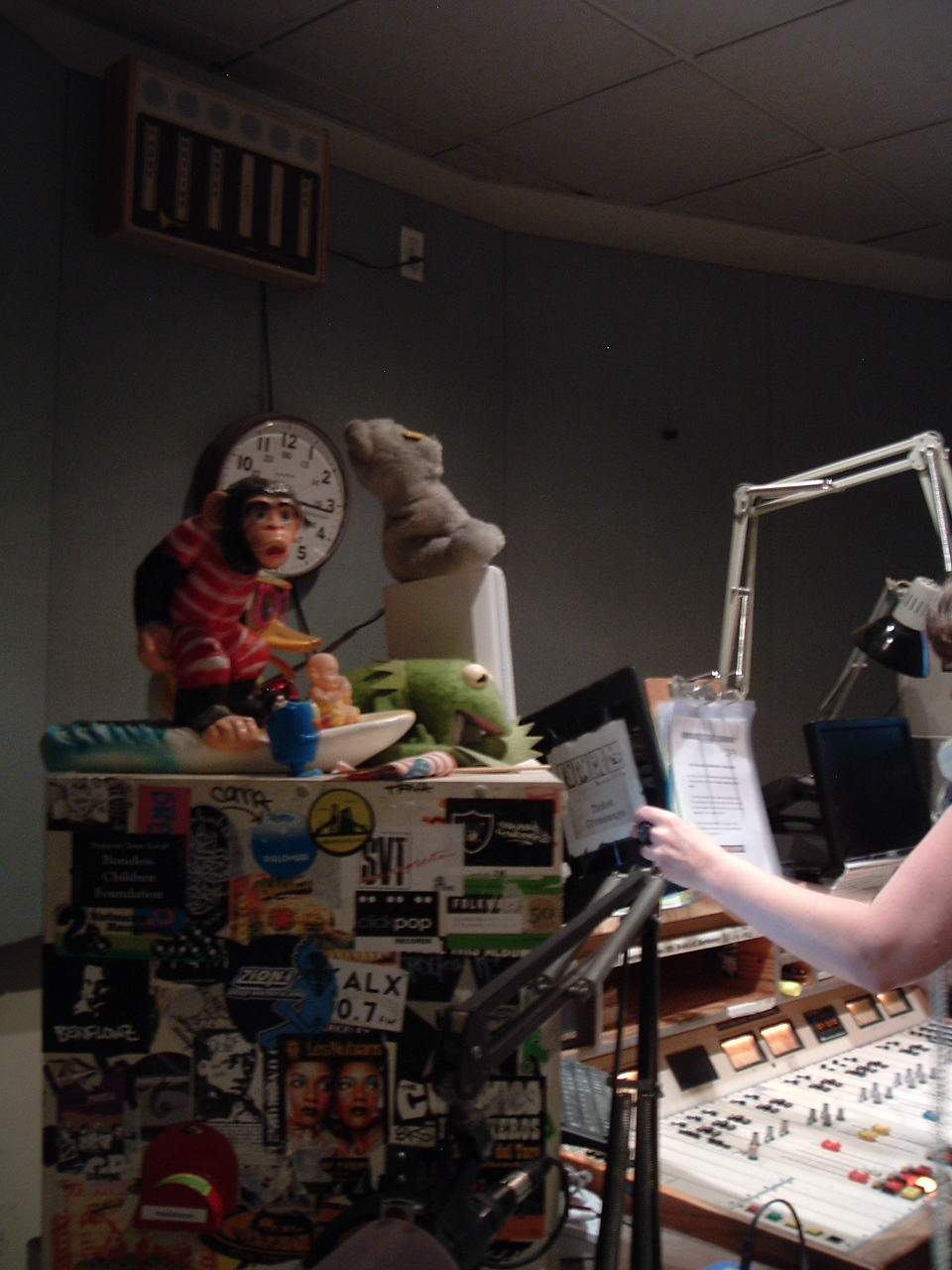
As Music Director, her role is to provide music options for DJs; although she is the first to admit that most DJs aren't investigating the music that she adds. She told me that they used to require DJs to play a certain percentage of new music, but that it was a challenge to get people to actually do it. In the past, Pirate Cat also asked every DJ to donate an album a month to the station. Music could have been solicited from labels, purchased, or been handed down from an individual's own collection. These days Katherine handles all of the music being added.

Katherine is mostly adding digital music, although she maintains a shelf of "hard copy" CDs in the studio for both new and local music. They don't intend to build a physical music library at the station and instead opt to just digitize any CDs that they want to retain the music from for future use by DJs. She said that it was a "hard choice" to go completely digital, but said, "we just don't have the space for a library," adding, "we're not an archive."

New and Local CD Library at Pirate Cat Radio

Although Pirate Cat has turntables in their studio, Katherine said that aren't in the best location for DJs. Stashed behind the mixing board, they are "out of the way" and frequently get broken. Despite these problems, there are some DJs who play all vinyl and there were a handful of vinyl records on the studio shelves. Katherine said that it's rare for the station to get sent any vinyl from record labels or bands.

Katherine adds a wide range of material to the station's library and it's up to DJs to decide what to play on their shows, as there aren't any format rules at Pirate Cat. Some of the current shows on the air include an all-Spanish language music program, a Greek blues show, a comedy program, news, and shows that play a mix of music from ska to reggae to electronic to punk. The one requirement placed on DJs is that they are supposed to do interviews on their programs or have live guests. Katherine said that by airing interviews, it "really connects the station with the community."

 
Pretty Swank for a Radio Station Couch!

Often there are live events at the station/cafe, including the Mission Underground Film Festival, various station benefits, and live music. Katherine agreed that, "people mostly come to try the latte..." Some locals are regulars at the cafe, including firefighters from a nearby station. She said that the neighborhood has been changing a lot recently, with a new art gallery and restaurants cropping up nearby.

Although DJs at Pirate Cat have a lot of freedom over the air, they do still have to abide by a number of station rules. Everyone has to volunteer for a station department, known at Pirate Cat as "ministries." Ministries include departments like Music, Public Service Announcements, PR and Marketing, News, and Interviews (to name a few). DJs are required to donate around 2 hours worth of work to the station every week and interns have to work in the cafe. In addition to that, there are station dues (which can be swapped for hours spent working in the cafe) and mandatory monthly staff meetings.

Pirate Cat Radio Doesn't Have the Band-Sticker-Covered Cabinet that Most Stations Have,
But Look at Their Trash Can!

During my visit I was surprised to see Pirate Cat founder Daniel Roberts hanging out at the station. Just a month before he had launched KPDO in Pescadero and I knew that he was just getting that station off the ground. He told me that he's been splitting his time between the two stations and said that he'd actually been at Pirate Cat four days that week. There are days when he'll spend a part of the day at each station, no small feat given the fact that it's more than an hour's drive between Pescadero and San Francisco.

Daniel said that he was pleased with how things were going at KPDO and when we spoke he had nearly 30 DJs working towards getting shows. As with Pirate Cat, he plans to have monthly staff meetings. One difference, however, is that KPDO DJs are asked to contribute 8 volunteer hours a week to the station. He said that there is so much that has to get accomplished there, that he has to delegate the work. One of his goals was to get the schedule filled with local DJs by the end of summer. At the time we spoke he was rebroadcasting Pirate Cat Radio programs on KPDO when there wasn't a scheduled DJ.
 Daniel Roberts and Pirate Cat Radio DJ La Pirata Margarita

As I wrapped up my visit, Katherine, Daniel and I looped back to a discussion about music and talked about the challenges of being a Music Director and trying to convince DJs to expand their musical horizons. Daniel said that at KPDO he's having the same struggles, made even more difficult since the station hasn't built up a library of music. While we spoke he began hauling the modest collection of the rarely-played vinyl out of Pirate Cat's studio, with the intention of bringing it down to KPDO.

In the weeks since my visit, Pirate Cat Radio has gotten a new coat of paint and a jazzed up menu (coconut curry mocha, anyone?) and KPDO has been fundraising (they want to boost the station's broadcast power and range) and connecting with the community through a summer film festival. I'm glad to see the passion for radio at Pirate Cat and to have witnessed the birth of KPDO. Thanks again to the DJs and staff of Pirate Cat Radio for taking the time to show me around their San Francisco digs.

View of 21st Street from Pirate Cat Radio Studio


Previous Spinning Indie Radio Station Field Trips:
Field Trip to WECB at Emerson College
College Radio Field Trip 2 - Cal Poly's KCPR
College Radio Field Trip 3 - Notre Dame's WVFI
Radio Station Field Trip 4 - WFMU in Jersey City
Radio Station Field Trip 5 - East Village Radio in NYC
Radio Station Field Trip 6 - WNYU in New York City
Radio Station Field Trip 7 - Northwestern's WNUR
Radio Station Field Trip 8 - Stanford's KZSU
Radio Station Field Trip 9 - University of San Francisco's KUSF
Radio Station Field Trip 10 - Santa Clara University Station KSCU
Radio Station Field Trip 11 - UC Berkeley's KALX
Radio Station Field Trip 12 - KSJS at San Jose State University
Radio Station Field Trip 13 - WBAR at Barnard College
Radio Station Field Trip 14 - KFJC at Foothill College
Radio Station Field Trip 15 - UC Santa Cruz Station KZSC
Radio Station Field Trip 16 - Haverford College Station WHRC
Radio Station Field Trip 17 - FCCFree Radio in San Francisco
Radio Station Field Trip 18 - Flirt FM in Galway, Ireland
Radio Station Field Trip 19- WRXP 101.9 in New York City
Radio Station Field Trip 20 - WGBK at Glenbrook South High School, Illinois 
Radio Station Field Trip 21 - KPDO in Pescadero, California 
Radio Station Field Trip 22 - KZYX in Philo, California

Tuesday, June 15, 2010

Ypulse Mashup 2010 Recap: Day One- Radio's Role in HIV Prevention, MTV's Digital Bill of Rights, Metal, and Mobile

Ypulse Mashup 2010

Although my main focus these days is on the worlds of radio and music, I've always had a strong affinity for teen culture. I did my college thesis on adolescent diaries, worked at an ad agency tracking youth trends on accounts like Levi's, spent most of grad school writing about youth-oriented TV shows like Buffy the Vampire Slayer, Real World, and Parker Lewis Can't Lose, and even worked for a dot com that helped teenagers to shop online without a credit card.

When I ran across Ypulse back in 2004 I thought that I had found a youth culture soul mate in its author, Anastasia Goodstein. She'd spent many years writing about young people and devoted her blog to chronicling the goings on in youth media and technology.

For the past three years Ypulse has hosted Mashup events, in which youth enthusiasts come together to learn about the latest in youth technology and media. These events draw marketers from both non-profit and for-profit companies, educators, journalists, and youth experts.

This year's event took place on May 24th and May 25th in San Francisco at the Hotel Nikko. As I did last year, I will focus my Spinning Indie coverage on the music and radio-related tidbits that I gleaned.


Youth, Health & Social Media Marketing Session: Radio is Still Relevant, But Mobile is Huge

A really cool theme throughout the entire conference was the importance of social causes and giving back. The first session that I attended featured several panelists talking about how their organizations reach out to youth in order to address various health-related issues.

Tina Hoff from the Kaiser Family Foundation shared some factoids (PDF) from their 2010 study, "Generation M2: Media in the Lives of 8- to 18-Year-Olds." It's an awesome study that reveals how much the media landscape has changed in the past decade. In terms of music and audio, she pointed out that according to their study, 76% of youth own an iPod/mp3 player, 66% own cell phones, and 29% own laptops.

Young people spend more than 2 and a half hours each day listening to music/audio, with 23% of that listening time through radio and 23% through computers. Twenty-nine percent of the time young people are choosing to listen to music through an iPod, 12% of the time listening is through a cell phone, and 12% of listening is via CDs. She also mentioned that in a typical day, young people are spending 17 minutes listening to music via their cell phone. Although her presentation just scratched the surface of the study, earlier this year I took a close look at the report and pulled out all of the radio and music-themed findings.

Trina DasGupta shared the case study "Mobile Matters: Youth Empowerment and HIV Prevention in South Africa" (PDF). She spoke about the project loveLife and how it's working to educate youth in South Africa about HIV prevention. And, interestingly, loveLife is making a significant use of both traditional radio and mobile to reach young people. In South Africa, the Internet is not the best way to communicate information, with only 10% of the country having Internet access.

Radio is still a significant form of communication and loveLife not only utilizes public service announcements, but also airs weekly programs on 11 stations and has an entire program called "Radio Ys" in which young people are getting trained in radio production and are hosting radio shows related to HIV Prevention. At the same time, loveLife has created a mobile social network since 75% of South African youth own mobile phones. It's a fascinating approach, using both new and traditional media.

MTV also shared some of the projects (PDF) that they are doing in order to advance social causes. Jason Rzebka talked about their latest project, A Thin Line, in which they are helping to raise awareness of digital abuse, as well as "It's Your (Sex) Life's" GYT (Get Yourself Tested) campaign and mtvU's attempt to address mental health issues (and erase the stigma of mental illness) on campus with "Half of Us."

In each campaign they've provided opportunities for MTV viewers to create content, submit stories, or write lyrics in response to various questions or challenges. One of the latest projects is an app called "Over the Line," which Jason described as a "digital morality meter." Through the app, people can submit and rate stories related to digital abuse, judging whether certain behaviors are over the line or not (for example, demanding access to a boyfriend's emails or texts). The day of the conference, MTV also launched a "A THIN LINE's Digital Bill of Rights", inviting youth to craft their own rules about how they want to be treated online (or via mobile devices), from protecting one's privacy to being safe from bullying.

As is always the case with MTV, social causes are incorporated within their programming, from "The Real World" to "16 and Pregnant" and music and musicians are often the message-bearers. (By the way, later in the day Jason also did a separate presentation (PDF) focused exclusively on the "A Thin Line" campaign).


Action Sports and Music: Vans Warped Tour as Rite of Passage

Next I dashed into a session about action sports because there was a presentation about the Vans Warped Tour, dealing with the intersections between music and sports. Kathleen Gasperini from Label Networks talked about how influential music and musicians are to young people. She said that the Vans Warped Tour (coming up in a few weeks) has become a "quintessential rite of passage for North American youth culture" and that music helps to forge connections between kids across both gender and ethnicity. She also talked a bit about music subcultures, from NuRave and Synth Punk to Metal. My favorite quote of the day came from her, when she said that metal never really went away, "it just went to Europe for awhile."

Radio, Music and Global Youth

I missed the session about Global Youth, but Ypulse has kindly posted many of the presentations on their website. One thing that caught my eye in the presentation about youth culture in China, was a slide on the "vintage trend" featuring a picture of a young person holding a boombox and sitting next to a dial telephone. I wonder what that means for terrestrial radio?

Ypulse's Dan Coates shared some figures about U.S. youth from Ypulse's research division. According to Dan, 17 to 26-year-old non-college students listen to radio (overall) an average of 7 hours a week compared with 4 hours a week for college students in the same age group. Non-college students listen to traditional radio an average of 5.1 hours a week (vs. 2.6 hours for college students), listen to online radio 1.3 hours a week (vs. 1.1 hours for college students), and listen to satellite radio 1 hour a week (vs. 0.45 hours for college students).


Archeological Dig of Student Backpacks: Condoms, Tampons, and Flash Drives

I love it when researchers do projects in which they delve into the lives of people in real-world settings. It's just WAY more interesting to talk to teenagers in their bedrooms, on shopping trips, or at their schools than to chat with them inside a sterile focus group facility. For the next presentation, Dan Coates presented findings from an audit of the contents of the backpacks (PDF) of more than one thousand high school and college students in the United States. He pointed out that for young people, a backpack is a "library, a workplace, a financial center, a medicine cabinet, a cosmetic counter, a communications hub, a safe deposit box, and a stash."

It was fascinating to hear about the range of items found in backpacks, from underwear to a "beat up apple," a "marginal banana," and a crucifix/knife. As you might guess, young people carry a lot of technology in their backpacks, including items to facilitate listening to music, such as MP3 players (57% of girls, 52% of boys) and headphones (42% girls, 41% boys).

Genevieve Bell at the Ypulse Mashup

Genevieve Bell's Keynote Presentation: An Anthropologist's Take on Product Innovation

In the afternoon we heard a keynote presentation from anthropologist Genevieve Bell. As the Director of the User Experience Group at Intel's Digital Home Group, she is fixated on "consumer-centric product innovation" and global research. I was very interested in her comments about "stubborn devices" like television, as many future tech-oriented folks seem to discount their ongoing relevance. She said that home TV viewing in the United States has actually gone up in the past 10 years to 4 to 6 hours a day on average, even though that viewing may be in the background while using other devices like laptops. She added that the fastest growing group of TV watchers is young people (aka millenials), with their viewing increasing by 18% in the past 6 years. [I'm super curious to know what Genevieve would say about radio, as it seems to be another stubborn device, being used by most, despite popular perceptions to the contrary]

Genevieve also argued that there may be a backlash against the "always on, always connected" lifestyle of mobile devices and social networks. She is seeing evidence of people turning off their phones in order to manage their relationship to mobile and has found that some people are turning away from online social networks.  She said that when a technology ceases to be "new" or "sexy," then people may end up using it less.

In terms of privacy fears, Genevieve argued that people now assume that all of their information is already out there and are in fact more afraid of certain pieces of information damaging their image or reputation. She said that people are afraid of others knowing "what we're really watching on television," because that could make them look uncool.

I was happy to see that Genevieve also emphasized that, "a globally located world doesn't end localness" and that there is "no single arc of technology adoption." In terms of radio, I've found that to be true, in that its power lies in its localness and in the fact that how it is used around the world can vary tremendously, depending on the other available forms of communication technology and media.

DJs from The DJ Project

Happy Hour with the DJ Project: Digital Turntables

The first day of the Mashup ended with a reception that featured young DJs from The DJ Project "spinning" music for the attendees. I was fascinated to see that the slabs of vinyl being manipulated and scratched on the 2 turntables were seemingly "blank" DJ records that were used to interact with digital music files on a computer. I chatted a bit with the DJs about this and they commented that it's a lot easier than lugging around a bunch of vinyl. It's the perfect reflection of the seemingly contradictory trends of music's digital future and the renewed interest in vinyl records.

It was awesome to see The DJ Project at Ypulse, as it's an amazing youth empowerment program in San Francisco that uses "music to engage young adults" and provides classes in audio production, DJing, and break dancing.

Thursday, May 27, 2010

Radio Station Field Trip 22 - KZYX in Philo, California

For over a decade I've been intrigued by community/public radio station KZYX in the small town of Philo, California. As I drove through the area during weekend get-aways to Mendocino and Anderson Valley I listened to the station and became a huge fan of their weekend show "Trading Time." After citing the show as one of my favorite radio shows of all time on Radio Survivor, I got a nice email back from KZYX's General Manager John Coate. So, with another trip planned to Anderson Valley, I decided to stop by the station on May 13th to learn more about what they are up to.

Philo is a small town located in Anderson Valley, which is about a 2 1/2 hour drive north of San Francisco on scenic highway 128. Known for its wines, Anderson Valley was a hub of activity when I visited KZYX two weeks ago, as it was the weekend of the annual Anderson Valley Pinot Noir Festival.

Back Deck of KZYX
Photo by Jennifer Waits

When I arrived at KZYX on a Thursday afternoon, I was directed out to the station's outdoor deck area to find General Manager John Coate. Situated in a rented house just off the highway, but nestled in the woods, KZYX's physical location couldn't be more idyllic for a small town community radio station. As we began to chat in the afternoon sun, it was hard to miss the mellow, country, hippie vibe emanating from both the speakers and from the surroundings. I was delighted by the sight of a lizard darting out from under a rock while we spoke and by the presence of a radio station dog.

 
KZYX in Philo
Photo by Jennifer Waits

Moments later the calm was disrupted by the buzz of a helicopter directly over our heads. As it continued to circle the station at a very low altitude, John and other staffers were both surprised and perplexed by its presence. We speculated that it was scoping out the woods for marijuana plants, as that's not uncommon in Mendocino County. But then the in-the-know locals quickly added that it was actually the wrong season for pot plant surveillance. After getting no response from the local airport, the collective theory changed and we were told that it was probably a rich tourist joy riding in advance of the Pinot Noir Festival.

After the excitement subsided, we continued our conversation and tour of KZYX. The FM station (at 90.7 in Philo) began in 1989 and has additional studios in Willits (KZYZ) and Mendocino, allowing the station to broadcast on a few FM frequencies in different parts of the country (as well as online). John has been the General Manager of the station since August 2008, after working for many years in new media. A pioneer in online social networking, he was employee #2 at "The Well," arriving there in 1986, becoming part of a very influential online community. He went on to found SF Gate, one of the first websites devoted to bringing newspaper content online.

KZYX Studio in Philo
Photo by Jennifer Waits

It was interesting talking to John about both new and traditional media, as much of what I love about KZYX hearkens back to an earlier time. Their call-in "swap" show "Trading Time" is truly a slice of small town life, as its hosts read off a laundry list of items that neighbors are offering up for sale or trade. Old refrigerators and pick-up trucks are proffered, along with requests for rides or for help hauling. John told me that it may be the most popular show on KZYX as it "speaks to commonalities" among listeners as opposed to a niche audience.

The programming at KZYX is interesting in that it includes a mix of music, public affairs, local, and syndicated shows. They air shows from NPR, PRI, APM and Pacifica radio, as well as their own locally produced shows. When I visited the station a DJ was doing a world music show and for that particular week she was focusing on music from Asia. John told me that most of the music shows are "specialty shows," playing a specific genre. He mentioned one DJ who only plays acoustic Delta blues music and another who plays Doo Wop on a late night show. KZYX has also broadcast live events, including a reggae festival.

KZYX General Manager John Coate in the Vinyl Library
Photo by Jennifer Waits

Half of the programming schedule is devoted to public affairs shows and John mentioned that they were doing a lot of local election coverage for an upcoming June election, including interviews, debates, and appearances by various candidates for judge, supervisor and district attorney. Archives of their election coverage can be found on their website. John pointed out that the election coverage has been quite lively, adding that "Mendocino...socially...is not that mellow," describing the local community as being quite engaged and "way more Berkeley" than "Haight Street." He said that the mission of the station is "to cover the county" entirely, adding that, "My job is to keep my views out of it." The station's one-person news department is actually run out of a caboose (a left-over train part from a chain restaurant in Japan) out behind the main station building

In talking about the role of KZYX for the community, John said, "We're serving up the whole person...it's a Renaissance approach." He added that since there is no local television station that reaches everyone, it's been important for them to be a community resource. Additionally, one transmitter isn't enough to cover all of Mendocino County, so KZYX invested in a second transmitter in Ukiah and a translator above Ft. Bragg. Local shows can be broadcast from any of their studios using ISDN lines. The combined moniker for all of their studios and frequencies is KZYX and Z.

Part of the International Library at KZYX
Photo by Jennifer Waits

I was happy to see that KZYX has a large music library, full of both vinyl and CDs. John said that vinyl does get played at the station. He also said that the local programming at the station is really good, adding that in particular the jazz and classical music shows are some of the best he's heard anywhere.

John also reflected a bit about the state of radio, arguing that music and culture used to be "propagated" over radio, but that today that seems to happen more "virally" in the online world through "attachments." He agreed that college radio is "still a potent force for developing culture" and said that it has launched music careers. He said that to him it's just important for DJs to focus on being "really good at what you do." Impressed by the devotion of KZYX DJs, John mentioned that one of the new music DJs will spend 6 hours planning for a 2 hour show. A few nights later I caught one of the new music shows, Amplified Mixtape, and enjoyed the DJ's pairings of cover songs and originals and was immediately taken by the fact that she played the first dance song from my wedding (Cat Power's cover of the Velvet Underground song "I Found a Reason").

KZYX General Manager John Coate looks out at the NPR Satellite
Photo by Jennifer Waits

As we left the station we were shown a large NPR satellite used to beam in programming and were then warned about a beehive in a tree. The juxtaposition of nature and technology could not have been more pronounced and seemed to be a metaphor for KZYX, with its blend of both folksy small town programming and slick syndicated public radio shows emanating from a funky station in the woods.

Previous Spinning Indie Radio Station Field Trips:

Field Trip to WECB at Emerson College
College Radio Field Trip 2 - Cal Poly's KCPR
College Radio Field Trip 3 - Notre Dame's WVFI
Radio Station Field Trip 4 - WFMU in Jersey City
Radio Station Field Trip 5 - East Village Radio in NYC
Radio Station Field Trip 6 - WNYU in New York City
Radio Station Field Trip 7 - Northwestern's WNUR
Radio Station Field Trip 8 - Stanford's KZSU
Radio Station Field Trip 9 - University of San Francisco's KUSF
Radio Station Field Trip 10 - Santa Clara University Station KSCU
Radio Station Field Trip 11 - UC Berkeley's KALX
Radio Station Field Trip 12 - KSJS at San Jose State University
Radio Station Field Trip 13 - WBAR at Barnard College
Radio Station Field Trip 14 - KFJC at Foothill College
Radio Station Field Trip 15 - UC Santa Cruz Station KZSC
Radio Station Field Trip 16 - Haverford College Station WHRC
Radio Station Field Trip 17 - FCCFree Radio in San Francisco
Radio Station Field Trip 18 - Flirt FM in Galway, Ireland
Radio Station Field Trip 19- WRXP 101.9 in New York City
Radio Station Field Trip 20 - WGBK at Glenbrook South High School, Illinois 
Radio Station Field Trip 21 - KPDO in Pescadero, California

Thursday, May 20, 2010

WFMU's Record Library Gets the Star Treatment

I talk a lot about my love for both radio stations and physical music. For me, the two go hand in hand. Part of the reason that I do a radio show every week is because I enjoy having access to a record library full of tens of thousands of CDs and records. Just this week I did a music special in which I pretty much relied on the station's archives since I don't personally own the music that I was playing. It's amazing to learn about some awesome band from the past and then find their LPs and 7"s safely nestled amid the other gems at one's college radio station.

Goldmine Magazine just started a new series where they will be visiting various record collections. Up first is their trip to New Jersey community radio station WFMU. This video does a great job of showing why WFMU DJs embrace vinyl and is the perfect companion piece to my recent PopMatters article "Technology and the Soul of College Radio, as it really depicts the magic of doing radio using physical music.


If you want to see more of WFMU, take a look at the post I did after touring the station in 2008.

Thursday, April 22, 2010

UCRN College Radio Conference Offers up Tips for DJs, Insights on Commercial Radio, and a Forum to Debate the Digital Future

On April 10, 2010 I got to spend the entire day fixated on college radio at the University of California Radio Network (UCRN) conference hosted by UC Berkeley station KALX. Held twice a year, these confabs for DJs and staff of University of California-affiliated radio stations are a great opportunity for shop talk and networking, but are also a chance to get a glimpse into the current struggles and debates within the music industry and college radio.

Last year I attended the UCRN event at UC Santa Cruz station KZSC and found it to be an amazing mixture of pragmatic sessions, music-focused panels, and intelligent discussion. This year's conference was similar, with sessions about broadcast law, the community and music, news and public affairs writing, how DJs can improve their on-air presence, and a panel about the future of music and media. Staff members from KALX also toured DJs around their station, the highlight of which is their meticulously organized music library containing more than 95,000 pieces of music.

 A mere sliver of the Record Library at KALX

There were around 70 people in attendance at the conference from KALX, KDVS, KCSB, KUCI, KUCR, KZSC, KSDT and upstart UC Merced station Bobcat Radio. And, many of the music industry panelists speaking at the conference had college radio pasts, making for interesting discussions about the college radio world vs. the commercial radio world. Unfortunately some sessions conflicted with each other, so I was only able to attend a selection of panels. Here's my recap of what struck me during the conference:

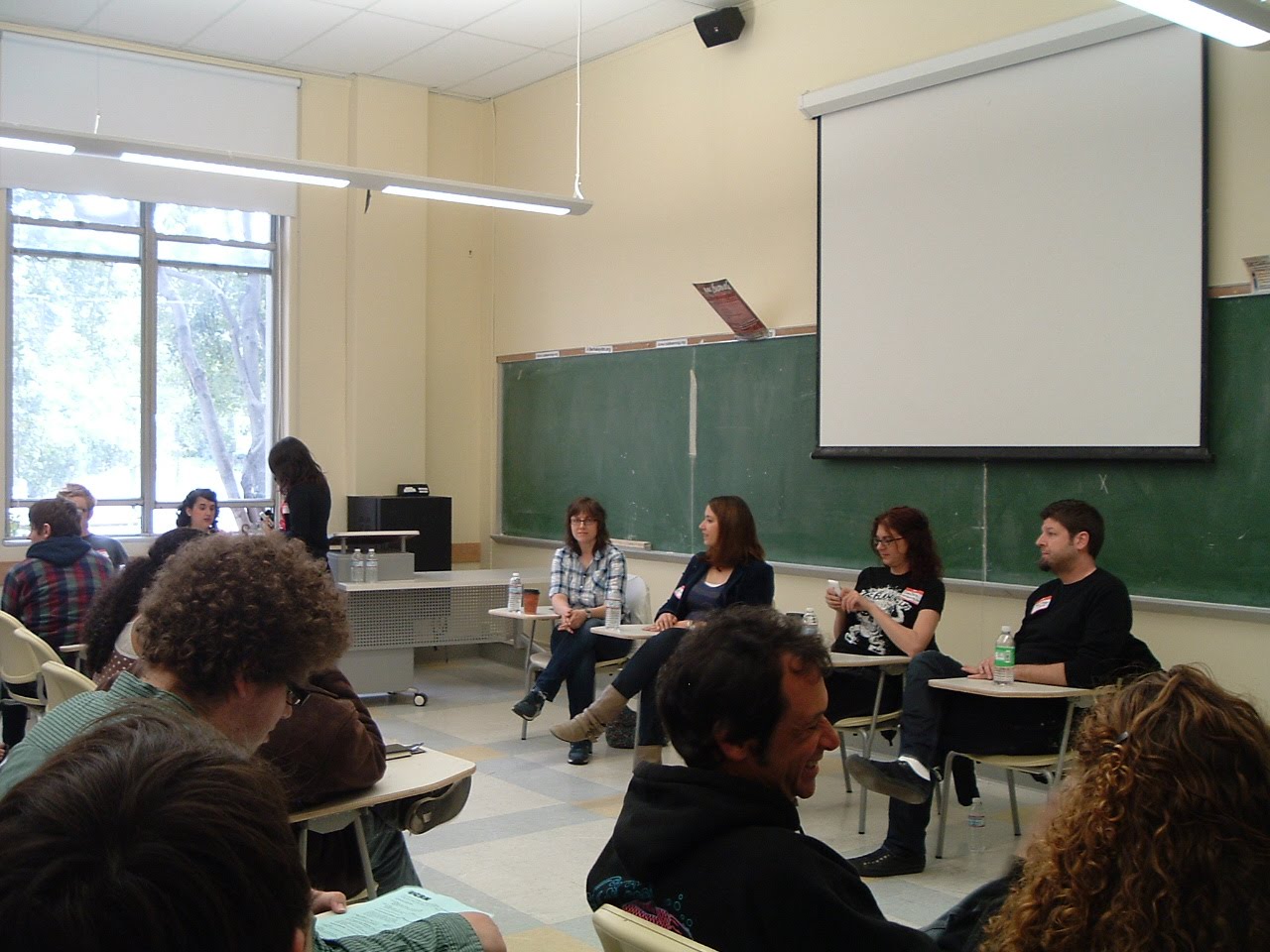
Community and Music Panel at UCRN
(L to R: Bev Elithorp, Joe Barham, Kathleen Wentz, and George Corona)

The Community and Music: Building Relationships Panel

This panel was fascinating to me, mainly because we got some great insight into the differences between college radio and commercial radio from KSAN (The Bone) DJ/Music Director Joe Barham (aka Joe Rock). Joe has been a DJ since he was in high school (at Mendocino high school radio station KAKX), with stints in both college radio at San Francisco State station KSFS and in commercial radio at a number of different stations. Other panelists worked at music promotions company Terrorbird, for a UC Berkeley concert series, and for local paper The East Bay Express.

Joe argued that with the way the radio and music industry is going, "it's almost an obligation that we pay attention to the local community." He pointed out that with the growth of digital music and services like Pandora, music listening is most likely "going in the direction of on demand [programming]." He said that although "radio's limited to playing something at a specific time," it can excel by continuing to play "original content" and by focusing on "localization." Joe does a Sunday night local music show "Local Licks" on The Bone and told the assembled crowd that that particular program is "the funnest part of my job," arguing that it's important to support one's local music scene.

 KALX DJ Doing a Show Amid the UCRN Crowds Milling About

Music promoter George Corona from Terrorbird (who used to be a college radio DJ at KXLU) shared his feeling that the "landscape for radio [is] shifting" and that "charting [on radio]...doesn't mean that [a band is] going to sell records."

Joe encouraged those in college radio to embrace the power and freedom that they have. When asked during the Q&A about the "forces" that he has to "bow to" in commercial radio, he replied, "The number one thing...We have commercials." Although everyone laughed at this reply, Joe argued that the commercials bring with them certain obligations. He talked a bit about the chaos in commercial radio saying that radio has been "kind of creamed" in the past 2 years and that there have been lots of firings and a great deal of flux in commercial radio staff. He said that being in San Francisco (the #4 market) gives him a bit more freedom, but that he has to answer to an out of town corporate Program Director when making certain decisions about programming.

Giving the crowd of college radio DJs a reality check about the commercial radio industry, Joe pointed out that they have to "play 450 songs over and over again" and that song list is a result of twice yearly music research in which potential radio listeners get to hear an 8 second sample of a song "in a hotel lobby." He said, "That's not art. That's robotic" and contrasted that with college radio, which he said is more like finding out about music from a "best friend."

Although all of the panelists offered up advice (start with an internship was the resounding suggestion) to those college radio DJs hoping to get into some aspect of the music business, Joe was pessimistic about the opportunities for music fans in commercial terrestrial radio, saying, "Don't do it." He was more optimistic about syndicated radio programs and about non-commercial radio where he said "music is art." He predicted that terrestrial radio "will die out," but added that there might be a glimmer of hope when stations rise from the ashes. Joe said that with all of the corporate radio bankruptcies (which aren't over yet), there could be a shift back to local, private ownership and that if that happens radio has the chance to change dramatically and for the better.

I was also interested to hear that The Bone is doing some interesting things programming-wise, not only with its local music shows, but also with Sunday night programming (Little Steven's Garage and Joel Selvin's radio show) that hearkens back to the freeform, underground radio days of the original KSAN. Additionally, Joe mentioned that The Bone airs a high rated all-request show in which music not normally in rotation gets played. His saw that as a sign that listeners really are interested in more than just the same short list of songs approved for airplay.

DJ and Programming Panel at UCRN
(L to R: "DJ Dave" Richards, Khris Brown and Shawn Reynoldo)

DJ and Programming Panel

Next, I sat in on a panel discussion about how to be a better DJ. As with the previous panel, one of the most interesting aspects of it was that one of the panelists had experience as both a college radio DJ and a commercial radio DJ. Shawn Reynaldo of XLR8R started at UC Berkeley station KALX six months after he began working at commercial station LIVE 105 (KITS-FM) as a phone operator. Eventually he became Operations Manager at KALX and a DJ and producer at LIVE 105. As we heard throughout the day, he talked about the importance of internships as the path to jobs in the music industry.

Shawn also pointed out that if you are DJing because you love music, then corporate, commercial radio is the wrong industry for you. He said that the music played at commercial stations comes from a "giant list that a middle-age white man" has compiled based on phone surveys and added that on college radio "you can experiment more."

In terms of specific advice that Shawn and others on the panel had for college radio DJs, here are some of the highlights:

1. "Drink water. Eat a green apple. Imagine your audience is your friend." - Khris Brown (KBA Voice Production)

2. "Pull more music than you need ahead of time...it's better to have too much." -Shawn

3. "Make an effort to expand your musical knowledge" and seek out advice from others at the station- Shawn

4. "Playing random things sounds like playing random things," so really think about your set -Shawn

5. When on the air don't apologize for your mistakes because the audience won't even notice them - Khris

6. Write notes before going on mic so that you remember what you need to cover - "DJ Dave" Richards

7. Be prepared for your shift and for mic breaks - Shawn

8. "Personality really makes a difference on the radio." Be yourself. -Shawn

9. Listen to the beginning and end of each track to ensure smooth transitions without dead air -Shawn

10. If you don't know what to say at the beginning or end of a mic break, say the name of the station - Shawn

11. When mixing sounds don't overlap voices or mismatch beats because "it sounds like shoes in a dryer." - Shawn

Panelist Prepare for the Changing Media Landscape Panel at UCRN
(L to R: Jody Colley, Corey Denis, Jillian Putnam-Smith, and Mike Cadoo)

The Changing Media Landscape: What is the Future of the Music and Media Industry?

The final panel of the day brought together everyone from the conference into one room to discuss the future of the music and media industry. As the KALX staff member introducing the panelists pointed out, "everything's transitioning to digital." This digital transition became the focus of the panel, with several of the panelists working almost purely in the online world.

This led to some tensions in the room as radio wasn't always acknowledged as being a part of this digital future. Corey Denis from Not Shocking Digital Strategies proudly said, "I don't deal with any traditional radio," but conceded that artists do still value radio and that college radio is particularly important for local musicians. She added that "unique programming is still going to be the backbone of radio." Mike Cadoo from digital-only label n5MD added that "[radio] charts are pretty valuable to a label" and said that his label services 200 radio stations in North America.

East Bay Express editor Jody Colley chimed in with the role that college radio plays in her job as the editor of a weekly newspaper that works hard to cover local music events, saying that college radio helps local music promoters identify talent because "college radio has always been on the forefront of finding the best bands." The East Bay Express just opened a music venue, so it's even more important for them to be tapped into the music scene.

Talk then turned to digital music and how it is stored and distributed. When discussing the possibility of housing music in "the cloud," located on servers far from one's own physical location there were concerns raised by both panelists and DJs in the audience. Jillian Putnam-Smith of online music company IODA acknowledged that artists seem to make less money from their music if it exists in this virtual space. One DJ said, "When I DJ...I'm being a fan, but I'm also selecting...instead of going to a faceless website and downloading." Another added, "We're a visceral, tangible educational resource" and stated that it's beneficial to have a "physical library [of music] with physical comments on [the material]."

At this point Corey made the claim, "College radio used to break bands. That doesn't happen anymore."

 New Release Bin at KALX

Corey asked the assembled DJs in the room if their stations accepted digital submissions and as far as I could tell no hands went up. Jillian (who used to be a KALX DJ) pointed out that for college radio stations it's often a very complex process to handle digital releases and navigate the password-protected systems put in place by promo companies.

A DJ in the audience then said that for college radio stations having libraries of CDs and LPs is important and that "the actual physical thing reminds you that it exists."

Later on in the discussion Corey added that if a college station created a system for accepting digital music submissions it would be "such a story" and encouraged stations to do so and hire grad students to develop this type of tool. Similarly, others in the audience wondered about the possibility of having digital music located in "the cloud" so that stations could access it without having to download it from promoter or label websites.

But, then the discussion turned back to the desires of DJs who want to be able to play physical music on their shows. Jillian agreed, saying that as a college radio DJ "you want to be able to go into your library and smell all the vinyl." Someone in the audience then brought up a concern about the sound quality of digital and the difference in sound between playing vinyl, CDs, or a stream off of MySpace over the radio. Corey's reply was that "audiophiles like us...We're not the general public" and she argued that people are being taught to expect lower and lower sound quality and that music formats have "degraded in sound over time" as vinyl made way for cassettes, CDs and digital files.

On the flip side, Mike agreed that there is a resurgent interest in vinyl, with vinyl-only labels cropping up. Jillian said that at IODA they create digital files from vinyl and that there's an entire online store ThinkIndie devoted to digital music converted from physical music, including vinyl.

 Audience for the Final UCRN Panel of the Day

Another DJ then brought up that he couldn't imagine preparing for his radio show without having access to bins of CDs and records and said that he likes that he "can see all the CDs...and the artwork" and that he wouldn't want to plan for his show by just going off of a list of music files. Inexplicably this comment caused Corey to launch into an attack on college radio. She complained about record stores being full of cast-off promo CDs and blamed college radio for selling off material, saying that bands pay $2 for that CD and when it gets sold off they don't make any money.

When I pointed out to her that it should be the responsiblity of labels and promo companies to identify stations that would be most interested in specific CDs, she backed off a bit, but didn't really acknowledge that the financial constraints of labels has a lot more to do with their push for stations to go digital than college radio stations getting rid of free CDs that they don't want. Her argument is quite similar to what I've heard on other panels, in which promoters said that they couldn't send out promo CDs anymore and that music stealing fans were to blame.

It was an interesting discussion to say the least and provided some great fodder for the piece that I was just finishing up for PopMatters about "Technology and the Soul of College Radio," so the timing of this debate couldn't have been better.

Thanks to everyone at KALX for allowing me to again be a fly on the wall at UCRN. It's an amazing event that is so beneficial to everyone who participates.

Tuesday, April 20, 2010

Record Store Day 2010 Delivered

Our collective haul from Record Store Day 2010

On Saturday I awoke and obsessively started scanning through Facebook commentary about Record Store Day in which people reported on where they went and what they bought (as of today there are more than 300 comments on a similar post from later in the day). Since I'm on the west coast, I enjoyed taking a look at initial reports from people visiting record stores in Europe and on the East Coast. Some reported long lines and others complained about their disappointment over not being able to get a specific "special" release. This worried me a bit, as I was hoping that people would embrace the concept of just patronizing their local indie record store, regardless of whether or not they were able to purchase a rare Record Store Day item. To me Record Store Day is more about raising awareness about the ongoing relevance of physical music and record stores and if that was its goal then I think it succeeded this year.

As I wrote on Radio Survivor, a number of radio stations joined in the fun this year. Some featured special programming, others had DJs spinning at record stores, and others just hung out at participating stores. I'm sure many college radio DJs were also unofficial participants, as I know many who hit up stores in their regions (and I personally spotted DJs from KZSU and KUSF during my visit to a store on Saturday).

Aquarius Records on Record Store Day 2010

I was thrilled to see that Aquarius Records in San Francisco was jam-packed with music fans loading up on goodies, from the free doughnuts to the limited edition Record Store Day releases. It seemed more crowded than at last year's event and from what I've heard Amoeba Records in San Francisco was also a hotbed of activity. We picked up a number of items at Aquarius, including a Mountain Goats DVD, the special Record Store Day Devo LP (they only had one copy), as well as some other CDs, LPs, and a couple of 'zines.

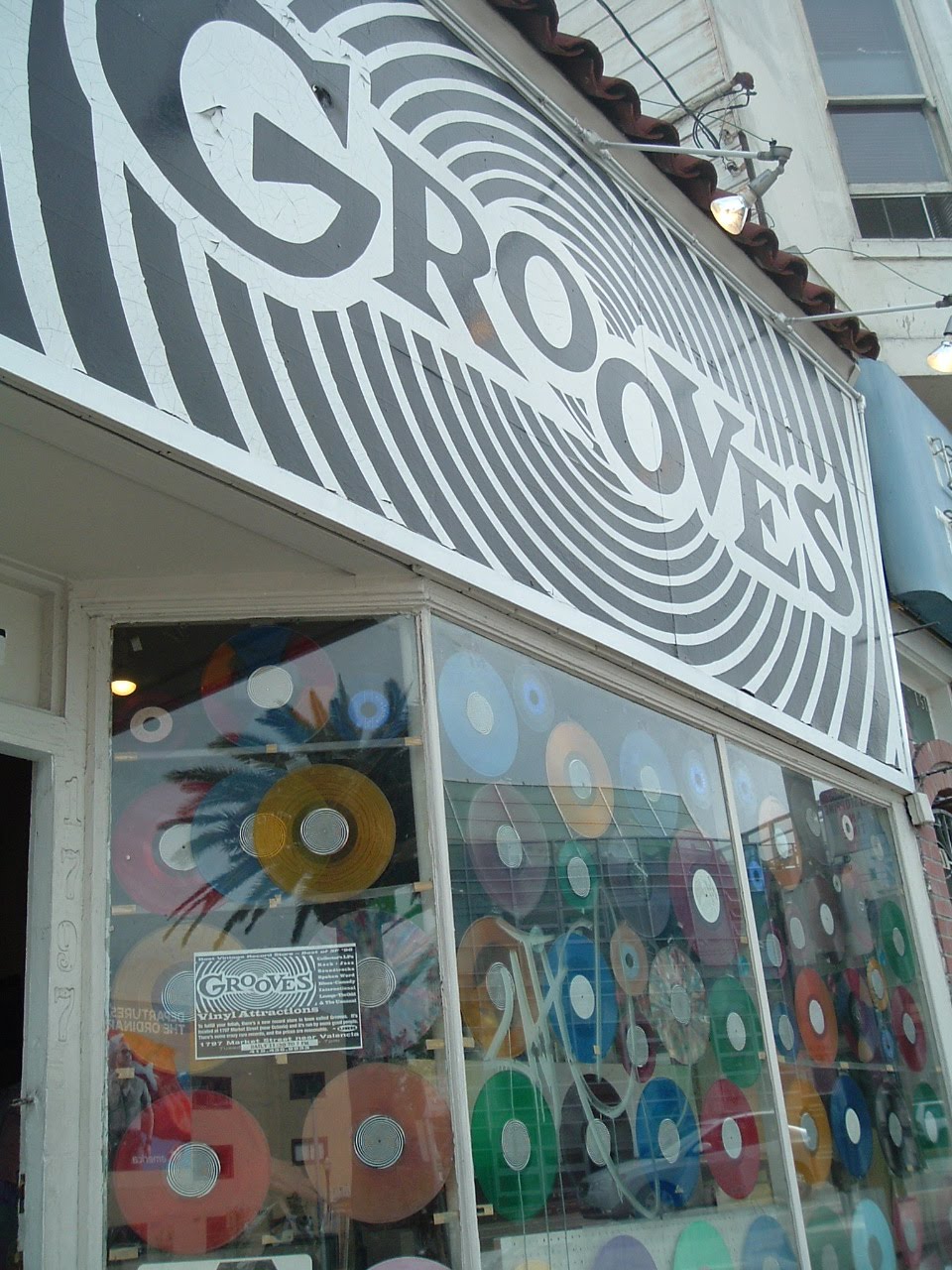
Grooves Records in San Francisco on Record Store Day 2010

After taking a break for food, we headed over to Grooves on Market Street to do some vinyl shopping. Although they weren't officially on the roster of Record Store Day participants, we wanted to go to support this amazing outpost for records. A handful of shoppers scanned through records, tapes and 8-tracks and we came away with some awesome finds, including a few wine appreciation records (I had no idea...), spoken word poetry LPs, some classic Disney albums for our 4-year-old, and a bust of J.S. Bach from a coin-operated arcade game.

On the blog Her Jazz, college radio DJ Maria Tessa Sciarrino posted an interesting critique of Record Store Day, calling it anachronistic and consumeristic. She writes,

"Record Store Day isn't relevant to right now. But we, collectively speaking, refuse to acknowledge this or attempt to break with past tradition. I'm not calling for the end of record stores, by the way, but I am all for the end of 'holidays' that reek of empty sentiment. If record stores are the genuine article, why are they doing something that is such a sham?"

Although I don't agree with Maria's overall sentiment, I do think that her point about raising questions about the event is valid. During Record Store Day I heard one clerk mention that this was the day for people to visit who don't normally go to record stores 364 days a year. If that's true, than perhaps there could be something a bit hollow about the event if it doesn't lure people into stores the rest of the year. But who knows, these people may actually become regulars after getting a "taste" on Record Store Day. What do you think? And did you partake in Record Store Day this year?