Showing posts with label mp3. Show all posts

Thursday, April 22, 2010

UCRN College Radio Conference Offers up Tips for DJs, Insights on Commercial Radio, and a Forum to Debate the Digital Future

On April 10, 2010 I got to spend the entire day fixated on college radio at the University of California Radio Network (UCRN) conference hosted by UC Berkeley station KALX. Held twice a year, these confabs for DJs and staff of University of California-affiliated radio stations are a great opportunity for shop talk and networking, but are also a chance to get a glimpse into the current struggles and debates within the music industry and college radio.

Last year I attended the UCRN event at UC Santa Cruz station KZSC and found it to be an amazing mixture of pragmatic sessions, music-focused panels, and intelligent discussion. This year's conference was similar, with sessions about broadcast law, the community and music, news and public affairs writing, how DJs can improve their on-air presence, and a panel about the future of music and media. Staff members from KALX also toured DJs around their station, the highlight of which is their meticulously organized music library containing more than 95,000 pieces of music.

 A mere sliver of the Record Library at KALX

There were around 70 people in attendance at the conference from KALX, KDVS, KCSB, KUCI, KUCR, KZSC, KSDT and upstart UC Merced station Bobcat Radio. And, many of the music industry panelists speaking at the conference had college radio pasts, making for interesting discussions about the college radio world vs. the commercial radio world. Unfortunately some sessions conflicted with each other, so I was only able to attend a selection of panels. Here's my recap of what struck me during the conference:

Community and Music Panel at UCRN
(L to R: Bev Elithorp, Joe Barham, Kathleen Wentz, and George Corona)

The Community and Music: Building Relationships Panel

This panel was fascinating to me, mainly because we got some great insight into the differences between college radio and commercial radio from KSAN (The Bone) DJ/Music Director Joe Barham (aka Joe Rock). Joe has been a DJ since he was in high school (at Mendocino high school radio station KAKX), with stints in both college radio at San Francisco State station KSFS and in commercial radio at a number of different stations. Other panelists worked at music promotions company Terrorbird, for a UC Berkeley concert series, and for local paper The East Bay Express.

Joe argued that with the way the radio and music industry is going, "it's almost an obligation that we pay attention to the local community." He pointed out that with the growth of digital music and services like Pandora, music listening is most likely "going in the direction of on demand [programming]." He said that although "radio's limited to playing something at a specific time," it can excel by continuing to play "original content" and by focusing on "localization." Joe does a Sunday night local music show "Local Licks" on The Bone and told the assembled crowd that that particular program is "the funnest part of my job," arguing that it's important to support one's local music scene.
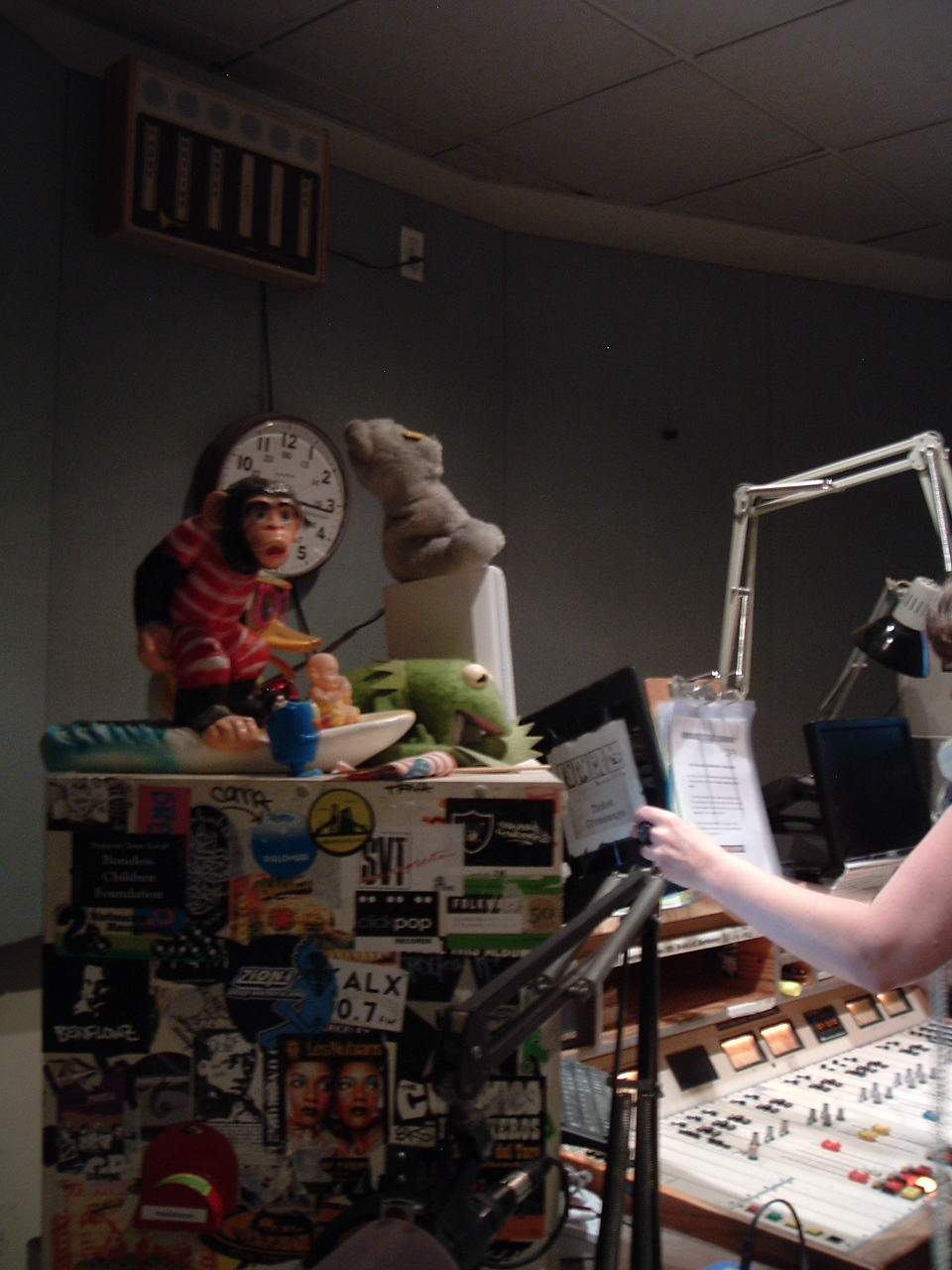
 KALX DJ Doing a Show Amid the UCRN Crowds Milling About

Music promoter George Corona from Terrorbird (who used to be a college radio DJ at KXLU) shared his feeling that the "landscape for radio [is] shifting" and that "charting [on radio]...doesn't mean that [a band is] going to sell records."

Joe encouraged those in college radio to embrace the power and freedom that they have. When asked during the Q&A about the "forces" that he has to "bow to" in commercial radio, he replied, "The number one thing...We have commercials." Although everyone laughed at this reply, Joe argued that the commercials bring with them certain obligations. He talked a bit about the chaos in commercial radio saying that radio has been "kind of creamed" in the past 2 years and that there have been lots of firings and a great deal of flux in commercial radio staff. He said that being in San Francisco (the #4 market) gives him a bit more freedom, but that he has to answer to an out of town corporate Program Director when making certain decisions about programming.

Giving the crowd of college radio DJs a reality check about the commercial radio industry, Joe pointed out that they have to "play 450 songs over and over again" and that song list is a result of twice yearly music research in which potential radio listeners get to hear an 8 second sample of a song "in a hotel lobby." He said, "That's not art. That's robotic" and contrasted that with college radio, which he said is more like finding out about music from a "best friend."

Although all of the panelists offered up advice (start with an internship was the resounding suggestion) to those college radio DJs hoping to get into some aspect of the music business, Joe was pessimistic about the opportunities for music fans in commercial terrestrial radio, saying, "Don't do it." He was more optimistic about syndicated radio programs and about non-commercial radio where he said "music is art." He predicted that terrestrial radio "will die out," but added that there might be a glimmer of hope when stations rise from the ashes. Joe said that with all of the corporate radio bankruptcies (which aren't over yet), there could be a shift back to local, private ownership and that if that happens radio has the chance to change dramatically and for the better.

I was also interested to hear that The Bone is doing some interesting things programming-wise, not only with its local music shows, but also with Sunday night programming (Little Steven's Garage and Joel Selvin's radio show) that hearkens back to the freeform, underground radio days of the original KSAN. Additionally, Joe mentioned that The Bone airs a high rated all-request show in which music not normally in rotation gets played. His saw that as a sign that listeners really are interested in more than just the same short list of songs approved for airplay.

DJ and Programming Panel at UCRN
(L to R: "DJ Dave" Richards, Khris Brown and Shawn Reynoldo)

DJ and Programming Panel

Next, I sat in on a panel discussion about how to be a better DJ. As with the previous panel, one of the most interesting aspects of it was that one of the panelists had experience as both a college radio DJ and a commercial radio DJ. Shawn Reynaldo of XLR8R started at UC Berkeley station KALX six months after he began working at commercial station LIVE 105 (KITS-FM) as a phone operator. Eventually he became Operations Manager at KALX and a DJ and producer at LIVE 105. As we heard throughout the day, he talked about the importance of internships as the path to jobs in the music industry.

Shawn also pointed out that if you are DJing because you love music, then corporate, commercial radio is the wrong industry for you. He said that the music played at commercial stations comes from a "giant list that a middle-age white man" has compiled based on phone surveys and added that on college radio "you can experiment more."

In terms of specific advice that Shawn and others on the panel had for college radio DJs, here are some of the highlights:

1. "Drink water. Eat a green apple. Imagine your audience is your friend." - Khris Brown (KBA Voice Production)

2. "Pull more music than you need ahead of time...it's better to have too much." -Shawn

3. "Make an effort to expand your musical knowledge" and seek out advice from others at the station- Shawn

4. "Playing random things sounds like playing random things," so really think about your set -Shawn

5. When on the air don't apologize for your mistakes because the audience won't even notice them - Khris

6. Write notes before going on mic so that you remember what you need to cover - "DJ Dave" Richards

7. Be prepared for your shift and for mic breaks - Shawn

8. "Personality really makes a difference on the radio." Be yourself. -Shawn

9. Listen to the beginning and end of each track to ensure smooth transitions without dead air -Shawn

10. If you don't know what to say at the beginning or end of a mic break, say the name of the station - Shawn

11. When mixing sounds don't overlap voices or mismatch beats because "it sounds like shoes in a dryer." - Shawn
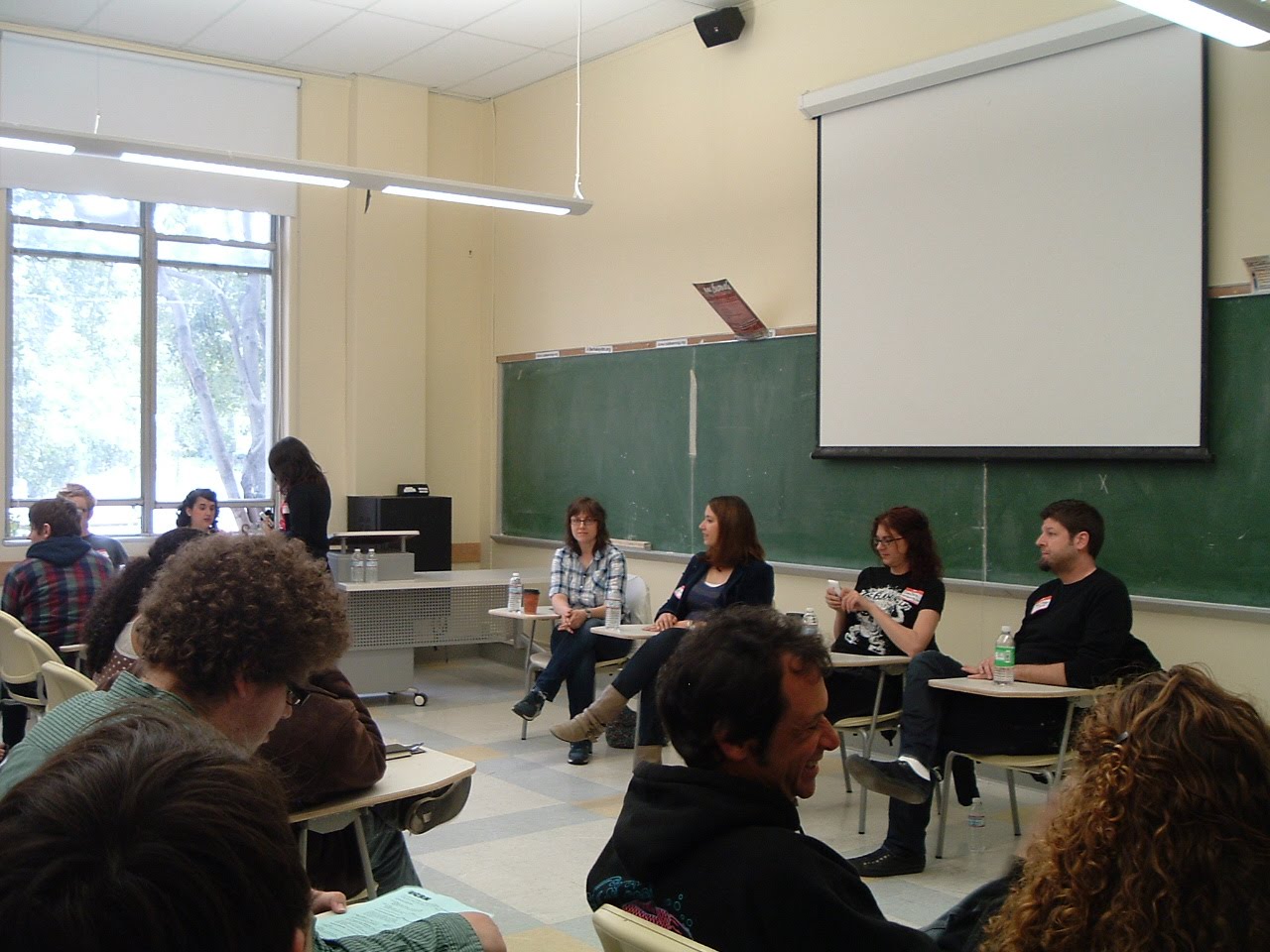
Panelist Prepare for the Changing Media Landscape Panel at UCRN
(L to R: Jody Colley, Corey Denis, Jillian Putnam-Smith, and Mike Cadoo)

The Changing Media Landscape: What is the Future of the Music and Media Industry?

The final panel of the day brought together everyone from the conference into one room to discuss the future of the music and media industry. As the KALX staff member introducing the panelists pointed out, "everything's transitioning to digital." This digital transition became the focus of the panel, with several of the panelists working almost purely in the online world.

This led to some tensions in the room as radio wasn't always acknowledged as being a part of this digital future. Corey Denis from Not Shocking Digital Strategies proudly said, "I don't deal with any traditional radio," but conceded that artists do still value radio and that college radio is particularly important for local musicians. She added that "unique programming is still going to be the backbone of radio." Mike Cadoo from digital-only label n5MD added that "[radio] charts are pretty valuable to a label" and said that his label services 200 radio stations in North America.

East Bay Express editor Jody Colley chimed in with the role that college radio plays in her job as the editor of a weekly newspaper that works hard to cover local music events, saying that college radio helps local music promoters identify talent because "college radio has always been on the forefront of finding the best bands." The East Bay Express just opened a music venue, so it's even more important for them to be tapped into the music scene.

Talk then turned to digital music and how it is stored and distributed. When discussing the possibility of housing music in "the cloud," located on servers far from one's own physical location there were concerns raised by both panelists and DJs in the audience. Jillian Putnam-Smith of online music company IODA acknowledged that artists seem to make less money from their music if it exists in this virtual space. One DJ said, "When I DJ...I'm being a fan, but I'm also selecting...instead of going to a faceless website and downloading." Another added, "We're a visceral, tangible educational resource" and stated that it's beneficial to have a "physical library [of music] with physical comments on [the material]."

At this point Corey made the claim, "College radio used to break bands. That doesn't happen anymore."

 New Release Bin at KALX

Corey asked the assembled DJs in the room if their stations accepted digital submissions and as far as I could tell no hands went up. Jillian (who used to be a KALX DJ) pointed out that for college radio stations it's often a very complex process to handle digital releases and navigate the password-protected systems put in place by promo companies.

A DJ in the audience then said that for college radio stations having libraries of CDs and LPs is important and that "the actual physical thing reminds you that it exists."

Later on in the discussion Corey added that if a college station created a system for accepting digital music submissions it would be "such a story" and encouraged stations to do so and hire grad students to develop this type of tool. Similarly, others in the audience wondered about the possibility of having digital music located in "the cloud" so that stations could access it without having to download it from promoter or label websites.

But, then the discussion turned back to the desires of DJs who want to be able to play physical music on their shows. Jillian agreed, saying that as a college radio DJ "you want to be able to go into your library and smell all the vinyl." Someone in the audience then brought up a concern about the sound quality of digital and the difference in sound between playing vinyl, CDs, or a stream off of MySpace over the radio. Corey's reply was that "audiophiles like us...We're not the general public" and she argued that people are being taught to expect lower and lower sound quality and that music formats have "degraded in sound over time" as vinyl made way for cassettes, CDs and digital files.

On the flip side, Mike agreed that there is a resurgent interest in vinyl, with vinyl-only labels cropping up. Jillian said that at IODA they create digital files from vinyl and that there's an entire online store ThinkIndie devoted to digital music converted from physical music, including vinyl.

 Audience for the Final UCRN Panel of the Day

Another DJ then brought up that he couldn't imagine preparing for his radio show without having access to bins of CDs and records and said that he likes that he "can see all the CDs...and the artwork" and that he wouldn't want to plan for his show by just going off of a list of music files. Inexplicably this comment caused Corey to launch into an attack on college radio. She complained about record stores being full of cast-off promo CDs and blamed college radio for selling off material, saying that bands pay $2 for that CD and when it gets sold off they don't make any money.

When I pointed out to her that it should be the responsiblity of labels and promo companies to identify stations that would be most interested in specific CDs, she backed off a bit, but didn't really acknowledge that the financial constraints of labels has a lot more to do with their push for stations to go digital than college radio stations getting rid of free CDs that they don't want. Her argument is quite similar to what I've heard on other panels, in which promoters said that they couldn't send out promo CDs anymore and that music stealing fans were to blame.

It was an interesting discussion to say the least and provided some great fodder for the piece that I was just finishing up for PopMatters about "Technology and the Soul of College Radio," so the timing of this debate couldn't have been better.

Thanks to everyone at KALX for allowing me to again be a fly on the wall at UCRN. It's an amazing event that is so beneficial to everyone who participates.

Friday, December 11, 2009

Radio Station Field Trip 20 - WGBK's Glenbrook South Radio


A few weeks ago I was driving around near Chicago, scanning the dial for interesting non-commercial radio stations when I suddenly became riveted by what I was hearing. The voices were young and it seemed clear to me that it must be a high school station.

As I continued to listen, I heard a public service announcement about depression, an ad for a high school newspaper, references to a recent loss by the girls volleyball team, a restaurant review for McDonald's, an investigative piece about a new trash pickup system, and a series of technical snafus and dead air. In terms of the music, it ranged from metal to Bob Marley to Tom Petty.

I was charmed and made it my mission to learn more about the station.

Broadcast Studio (Studio K) at Glenbrook South High School

As it turned out, the station that I was listening to, WGBK, was indeed a high school station located in the suburbs of Chicago near where I was staying with family. The Saturday morning programming that I was treated to was produced by students at Glenbrook South High School in Glenview, Illinois. I later learned that Saturday mornings are reserved for DJ trainees; so the on-air struggles and dead air that I heard could be attributed to that.

From the archives... a cart machine at WGBK

WGBK broadcasts in the Chicago suburbs over 88.5 FM. Their FM programming is split between two high school stations: Glenbrook North and Glenbrook South; with each school handling programming on different days of the week. Each station also has their own separate webstream.


The school district purchased the station in 1997 from a Christian day school (Midwestern Academy) which had run the previous station under the call letters WMWA. In the period prior to the sale, WMWA offered the district air time and this began with broadcasts of sporting events and evening programs by radio students at Glenbrook South beginning in the 1980s.

WGBK's Original Board from the 1980s

Thanks so much to the students and staff of WGBK for welcoming me to their station on the afternoon of November 16, 2009. I sat down with station adviser/broadcasting teacher Dan Oswald (known to his students as "Doc") to talk about the radio program at Glenbrook South, with which he has quite a history. Dan was actually a student at Glenbrook South from 1988 to 1992, starting his "radio career at 13." He has been in charge of the station as a faculty member since 2004. Dan told me, "it's nice to come back to a program that I got a lot out of." During his tenure as a faculty member he's been able to take the station online and 24/7.

Some Vintage Vinyl from their Collection

This was my first visit to a high school radio station and I was both jealous and impressed, since I didn't have the opportunity to do radio at my high school. Glenbrook South is a large suburban high school on Chicago's north shore with gorgeous facilities. They have a broadcasting department, with a number of radio classes available for students. Between 130 and 140 students participate in radio classes and/or work at the station. Right now the majority of those kids are boys, with girls making up only about 10% of radio participants. Dan said that he's been working on increasing partcipation by girls, saying, "I would like more young ladies to take radio."


The Glenbrook South station, which broadcasts over FM on Mondays, Wednesdays, every other Friday, and on Saturdays is programmed like an "alternative rock station" with a "college radio feel," according to the station's adviser Dan Oswald. Like many college stations, they report their charts to CMJ.

Sticker-covered cabinet

Generally the station is live on the air in the afternoon and evening, from 3:30 until 10 or 11pm. They can be on the air as long as they like on their scheduled days, with the one stipulation being that an adult supervisor must be present. Many retired radio teachers from the program stick around as supervisors, including Mr. Weiss, who I met on my visit.

When they don't have live DJs they broadcast automated programming. On Tuesdays, Thursdays, and alternate Fridays the broadcast transitions to the station at Glenbrook North High School beginning at 6am. Each high school has their own studios, but they share a frequency. Dan said, "we're one station...our programming complements one another." He noted that the station is a "window" into the school community since it airs both schools' sporting events, a range of music, documentaries and public service announcements.


Glenbrook South's station is the result of a rigorous radio program, which Doc says he teachers like a college course. All advanced radio students also have jobs at the station, much like one would in college radio. They have been recognized with numerous radio awards and according to Doc, the station has won numerous John Drury High School Radio Awards.

Their online stream (facilitated through Live 365) has seen listeners from Ireland, Canada, Argentina, and Belgium. Alums from the program include not only the station adviser, but also Fall Out Boy's Patrick Stump and the young music journalist behind MissExclusive.


DJs at the Glenbrook South station do still play CDs and vinyl, but mostly use mp3s. I was very impressed to see that they do maintain a vinyl library and the students who toured me through it noted with pride that they value the station's history and music collection. The Radio Club began at Glenbrook South in 1981, so there is some music dating back to the 1980s in their library. Additionally, when the station was purchased from WMWA they also aquired that station's music.

Vinyl Library

I talked with a few of the student DJs, including Alex (one of the station managers) about their take on the future of radio. Alex said, "when I do my show...I like to do radio the way....I would want to hear it...playing more music....less talk....[for a] classic radio vibe." He also admitted, "I still like to listen to my iPod," saying that he does more iPod listening than radio listening.


New Music Director Blake said, "I had no idea that radio was dying at the time that I joined [the station]," but isn't particularly focused on the "movement to change that" either. Like Alex, he told me that he wanted to do radio that represents what he'd like to hear, including a "balance of talk...music...and news."


It was clear from my visit that WGBK was a special place and that the students in the program had a great deal of respect for their adviser and pride in the work of their station. It brought back memories for me of my experience on my high school newspaper, as we also had an inspirational adviser with high expectations. That combination can be magical and I was happy to see students who had this opportunity to do radio.


According to Doc, many graduates of WGBK go on to work in college radio; and the DJs who I spoke with also expressed interested in continuing their work in both radio and music production.

Thanks again to everyone at WGBK for showing me that radio is alive and well on at least one high school campus.

The requisite radio station couch in the "employee lounge" at WGBK

Previous Spinning Indie Radio Station Field Trips:

Field Trip to WECB at Emerson College
College Radio Field Trip 2 - Cal Poly's KCPR
College Radio Field Trip 3 - Notre Dame's WVFI
Radio Station Field Trip 4 - WFMU in Jersey City
Radio Station Field Trip 5 - East Village Radio in NYC
Radio Station Field Trip 6 - WNYU in New York City
Radio Station Field Trip 7 - Northwestern's WNUR
Radio Station Field Trip 8 - Stanford's KZSU
Radio Station Field Trip 9 - University of San Francisco's KUSF
Radio Station Field Trip 10 - Santa Clara University Station KSCU
Radio Station Field Trip 11 - UC Berkeley's KALX
Radio Station Field Trip 12 - KSJS at San Jose State University
Radio Station Field Trip 13 - WBAR at Barnard College
Radio Station Field Trip 14 - KFJC at Foothill College
Radio Station Field Trip 15 - UC Santa Cruz Station KZSC
Radio Station Field Trip 16 - Haverford College Station WHRC
Radio Station Field Trip 17 - FCCFree Radio in San Francisco
Radio Station Field Trip 18 - Flirt FM in Galway, Ireland
Radio Station Field Trip 19- WRXP 101.9 in New York City

Friday, November 6, 2009

CMJ 2009 College Day Part Two: Music Directors' Summit

Music Directors' Summit at CMJ's College Day 2009

So, if College Day was a big draw for me at the 2009 CMJ Music Marathon this year, then the annual Music Directors' Summit on that day could be considered the icing on the cake. Last year's MD Summit was a real eye-opener for me and this year's was even better.

Moderated by Chad Reich of KBUT (a community radio station in Crested Butte, Colorado), the panel also consisted of Joni Sadler from CHUO (University of Ottawa, Canada), Chris Payne from WTSR (The College of New Jersey), Kayla Morrison of KUPS (University of Puget Sound, Tacoma, WA), and Nick Inzucchi from WVKR (Vassar College, Poughkeepsie, NY). Everyone on the panel was a Music Director or Specialty Music Director at a college radio station.

Role of the Music Director
Chad began things by talking about the job of Music Director (MD) to "sort through the clutter" while receiving "very little pay or none" and having to "deal with a lot of issues." He said that he typically gets between 20 and 50 records a week.

Picking the Music
Jodi from Canadian station CHUO said that she strives to be diverse in her music adds, while avoiding "the mainstream top 40 songs." Kayla added that KUPS is the only independent station in Tacoma, Washington, so they try not to add major labels and try to focus on local music. Nick from WVKR said that at his station they are "trying to help emerging artists." He's a genre-director, so in his role he's only adding maybe 2 CDs every week.

Community DJ at KSJS

Playing Music by Established Artists and the Role of Community DJs ("Ancient Old Dudes") at College Stations
Chad asked the panel how they handle new music from older artists like Radiohead and Built to Spill. Nick (whose emphasis is on electronic music) replied that there are not "too many old electronic dudes who are still touring," so it wasn't much of an issue for his genre-area. Wow! I'm not sure that I believe that....and certainly there are reissues by established electronic acts.

From there the conversation turned to us oldsters who are still in college radio after all these years. Nick mentioned that community DJs, aka "the ancient old dudes...know music like the back of your hand" and added that they are the ones who "bring a lot of history to the station" as well as older music.

Chad concurred, saying that at his station they have DJs who've been at the station for 25 years and that those DJs are "not exactly breaking new [music]."

I find this perception of older DJs to be quite interesting, especially since I'm at a station with lots of long-time DJs who are still really devoted to exploring new sounds. I wonder if this is a real departure from the norm?

Reviews, Rotation, and Getting DJs to Play New Artists
Next the conversation turned to methods for reviewing new music and rotating it through the station. Chris said he tapes a review on every album that he adds to the station. Joni mentioned that she also puts reviews on every CD and also talks to individual DJs in order to recommend certain releases to them. Kayla creates a mixtape for DJs every week, where she pulls a track from each new CD and sends it along so that people are checking out the new music. She also has instituted a rotation system in order to get DJs to play a more diverse mix of music. Music is color-coded as yellow, green, or blue and DJs must play at least one track from each color category every hour. Nick said that at his station DJs have to play 5 rotation tracks every hour.

Playlist Requirements or Freeform?
Kayla said she interviews all prospective DJs and choses the ones who are interested in new music. Chris's station is not freeform and DJs must play a certain number of tracks from various rotation categories every hour during dayside programs (5 heavy, ? light, 3 back library, 1 local).
Jodi said that all Canadian stations must play 35% Canadian content, but other than that, her station is freeform.

Vintage Adds Lists from KZSU

Coming up with Top Five Adds
Chad asked the Music Directors to describe how they come up with their "Top 5 Adds" list to share with promoters. Kayla said, "I listen to every record...at least one song...That is my job." She picks her top 5 adds based on what she and her assistant like and she spreads them out among promoters "to be fair." She added that she only adds stuff that will get played or will chart with her DJs.

Chris concurred that he likes to spread his adds across promoters.

Jodi shocked the moderator when she said, "We don't do Top 5 adds." She explained, "We are notoriously slow for getting mail" and argued that they don't want to do a "popularity contest" between promoters. Additionally, since they are a freeform station, it's impossible for her to even guess what the top 5 adds might be.

Chad said that he adds the best 5 records every week and also does charts weekly.

MD Job as Balancing Act of Being DJs' Friend and Boss
The panel talked about the tough job of being MD, where on the one hand you need to be friends with your DJs, but you also need to sometimes be "the boss." Kayla said that she's lucky in that her DJs are all students, so it's not as "awkward" as it might be at a station with older community volunteers where you're telling someone "my dad's age...you can't play the Rolling Stones." She acknowledged that she is at a small school, so people still may hate her, but that's OK.

KSCU Music Department Wall

Digital Revolution
Chad pointed out that the digital revolution is "happening," but that it's a lot of work for Music Directors. On the plus side, the movement toward digital music "can solve a lot of problems" like overflowing shelves and drawers. Nick said his station has a lot of space issues and as a result they have cleared out jewel cases and are using plastic sleeves instead for CDs. They also have a "sweet robot" that can digitize 400 CDs at a time. Even with that, he said it will take 4 years to digitize the whole library. He argued that the conversion process is still a "huge pain" and that "getting a CD in the mail is so much easier at this point."

On the downside, Chad said that when you go digital, you're "missing out" by losing the physical copy of the music, with liner notes and "artwork...you'll never be able to replace with digital music." Nick also argued that although "it's true that you save money" with digital releases, he wondered if the promotional effort has the same effect.

Monitoring DJs' Playlists and Making Sure they Aren't Just Playing iPod
The panel offered up suggestions on how to monitor DJs. Chris recommended listening to peoples' shows and said that his station makes DJs keep a log of what they've played. Kayla said that at her station DJs are not allowed to plug in iPods. DJs must keep track of their playlists using an online program and they have playlists going back for a decade. She looks through those lists and will send warnings out to DJs playing mainstream material (she gave the example of Destiny's Child) and those DJs won't get shows the next semester if they continue.

Making Sure You Aren't Too Influenced by Promoters
During the Q&A a Music Director asked how other MDs make sure their new adds aren't too influenced by the promoters sending the music to the station. Chris mentioned that there are plenty of good CDs "not being worked by promoters" and also emphasized the importance of adding local music. Kayla gets around this by having an assistant who does not talk to promoters so that she can be "an inpartial judge" of the music. She also gets second opinions from DJs when deciding on what to add.

Playlist at KCPR from Fall 2008


Lazy DJs Not Tracking Their Playlists
There was talk during the Q&A about lazy DJs who don't input their playlists during their shows and how to get them to keep track of what they are playing, especially when it's a small staff and they can't afford to lose DJs. Chad agreed that this can be a challenge, saying that at his station there are DJs in their 60s and 70s who "refuse to deal with technology." He suggested talking to the DJs to get a sense of what they like and are playing, adding, "they're volunteers...you can't fire them." Nick added, "I sympathize with the lazyness...it's really tedious to chart your show" and it sounded like he wanted a more automatic tool to help him do so. In terms of learning what DJs play, he said that what works for him is direct communication with DJs.

What was most surprising to me about this discussion was the acceptance of DJs not keeping track of plays and the sympathy for how difficult it is. I'm kind of floored to hear that DJs and MDs think it's hard to keep a playlist, especially when most of these stations have a digital method for tracking plays. I'm guessing that the lazy DJs are the ones who are mainly playing digital music from their own collections and/or are creating their playlists in advance of their shows on iPods. For them, perhaps, it's a challenge to have to go back and figure out what they played when. I find this really really alarming and see it as part of a broader trend of radio becoming a less active task. Selecting and playing an mp3 takes less work than choosing and playing CDs and playing a CD takes less work than playing a piece of vinyl and with all of that the DJ's job becomes more and more sedentary.

Record Library at KALX

Valuing the Library
In a discussion about the how music libraries are valued at college radio stations, Chad argued that the music "library is your lifeblood" and that people should "feel really bad...[if they] mess with" it. Chris said that his station is working to digitize their back library of material dating back to the early '90s and late '80s (that's old?!). They keep music that was in high rotation or that charted on CMJ on their "back wall" and move other material to an accessible back room.

Nick said his station doesn't really have a problem with theft and that people tend to just burn things instead. He said "taking pride in your station" is important. Joni mentioned that they used to let people borrow music, but soon that became problematic. DJs are allowed to rip CDs and theft has been reduced dramatically. They additionally deface all of their music.

Getting Mainstream DJs Interested in Newer Music
Suggestions for getting DJs to check out new music included having one-on-one conversations with them and inviting them to review new music.

Box at WNYU

Role of Vinyl
The MD of KVCU (Boulder) asked about the role of vinyl at various stations. She said her station loves vinyl and has 4 turntables in the studio. Chad said that "everything sounds better on vinyl" and argued that stations "should keep that stuff." He mentioned that he's seen MDs try to purge vinyl and he's against that, adding, "we have DJs who play cassettes and DATs still." Chris said that at his station he led a seminar on how to use turntables and added that in their library they have a lot of great bands, like Talking Heads, where they only have vinyl.

Joni said that vinyl actually does better at her station than CDs "by a long shot." She added that she wants to make turntables part of the on-air training since "vinyl is huge with us." Joni also pointed out that many local bands are issuing material on vinyl. Nick said he really likes getting sent vinyl and that the station's vinyl library has "a lot of history" and is "more personal."

Doing a Digital Show vs. Playing CDs and Vinyl
I asked the panel if they saw a difference in the DJ experience and airsound of shows where the DJ is playing solely digital vs. physical music. The comments that I got back were strongly in favor of physical music, with terms like "soul-less" and "lazy DJ syndrome" used to describe DJs who come in and do a show that's pre-planned on their iPod. Chad said that the iPod "eliminates the need" for a DJ and argued that if you're "not working the board" then it's "not DJing to me."

Joni concurred, saying, "you have to avoid...pre-recording large segments of your show." Chris added that playing pre-recorded material isn't that much different from automation and it "sucks the life out" of one's show. Chad agreed, saying making playlists in advance, pre-recording shows, and "not using the shelves...undermines" the goals of the station.

It was really refreshing to hear that this group of Music Directors still believes in DJs doing more active radio shows.


Previous Posts about the 2009 CMJ Music Marathon:

CMJ 2009 Band Name Trends Revealed
Radio is Alive and Well at the CMJ Music Marathon (for Radio Survivor)
Radio's Presence at CMJ
CMJ 2009 Music Marathon Recap Part Two (10/20/09)
Social Networking, Metal Radio & Digital Music, and Miles Davis in 1959 (10/21/09)
CMJ 2009 College Day Part One- College Radio and Competition

Tuesday, November 3, 2009

CMJ Music Marathon Recap Part Three: Social Networking, Metal Radio and Digital Music, and Miles Davis in 1959

CMJ Exhibitor's Loft

The second full day of the CMJ Music Marathon took place on Wednesday, October 21, 2009. Panels began bright and early (for this crowd) at 11am at NYU's Kimmel Center and continued to focus on helping musicians to succeed in the music biz. Topics ranged from artist management, to the ins and outs of major label contracts, to the independent music market. A few genre-specific panels touched on dance, jazz, and metal and Andrew W.K. gave a keynote presentation.

Here's an overview of what I saw and heard on Day Two of CMJ:

Watching Sessions at CMJ

iLike It When YahoogleMyFaceTunes...You Tweet

Unfortunately this panel about music and social networking left me rather bored, as buzzwords flew around the room and I had a hard time focusing on what was actually being said. I think I was negatively predisposed when things started out with this comment by the moderator, "...the panel represents lots of pieces of the value chain." Uh oh. We also heard about how musicians need to "communicate offers to monetize," and should be aware of their "core competency."

I'm never a fan of business lingo, so the usage of these terms seemed to just zap the soul out of the conversation for me. And we're talking about music, one of the most soulful creations around.

We also heard that "somebody's back end is another person's front end," which, happily elicited much laughter from the panel and audience.

Most interesting to me was the discussion of music bloggers. Panelist Jason Herskowitz argued that with the declining influence of radio, music bloggers "are like the new music directors." I'm sure that's true for a lot of people, with those blogs serving as an entry point into new sounds. Similarly, Edith Bellinghausen from Razor & Tie suggested that music blogs are the new music press today.

Metal Radio Panel (not pictured-Jen Graham)

Keeping Metal Radio Relevant in the Digital Age

I was excited to see this discussion, as it was the first radio-specific panel of CMJ this year. Although ostensibly about "metal radio," the conversation was really more about the transition to digital music (from CDs and vinyl) and how that affects radio stations. As in similar panels last year, it was pointed out that the transition away from CDs to digital music is inevitable, mainly because of cost-cutting measures in the record biz.

The benefits of digital music were touted, with Jen Graham from Metalblade arguing that with digital music labels and promoters are able to provide as many copies as they'd like to radio stations and there's no fear of "lost mail" as there was in the past with CDs.

Jose Mangin of SiriusXM pointed out that he initially had problems with digital releases, but has come to realize that "it's about the music," regardless of what format it's on. He did make the point (echoed by many radio programmers) that for him downloading an album is still "a lot of work."

Music promoter Dan Rodriguez said that he's gotten a lot of "angry emails" from stations who are against digital-only releases. He added, "I have people threaten to not work with me" because he isn't able to send them physical copies of new releases. He admitted that he does "tailor a list" of stations to which he sends CDs.

An audience member then commented that much of the ire from stations may be because the "technological solutions" for handling digital releases just aren't easy. He said that it's "super frustrating" and asked, "Why is the process so complicated?"

In addition to this lack of standardization for digital releases, some stations simply don't have the proper equipment to process the music. Dan said that he's heard from some college radio stations that they did not have the technology to handle digital downloads, telling the crowd that some stations have "Macs from the mid-90s," don't have CD burners, and some even have staff that say they don't know how to burn a CD or play an mp3.

The handful of Promo CDs that I Collected at CMJ
(note the CDs promoting the music of New Zealand, Australia, Ireland, and Sweden)


The panel offered up various suggestions on how promoters and labels can streamline digital adds, including using the iTunes podcast feature or using one's own dedicated server.

Dan said that "there is no standard...for servicing radio digitally," pointing out that there are 6 or 7 different programs to faciliate it. Others use zip files and dedicated servers. He later said, "I wish there was an iTunes of radio servicing." (Hmmm....there's a business opportunity for Apple!)

From the discussion it also became clear that every station is different in terms of the information that they'd like to have along with a digital release. Some stations need to see all lyrics and album covers so that they can review the content for potentially objectionable material.

Many college radio folks in the audience also pointed out that they only add CDs to their libraries. So, for them, it takes time, work, and money to burn a CD. One Music Director said that she'd appreciate it if she was sent a "jewel-case friendly" info sheet along with the music, as she ends up having to cut things up in order to make them fit into the case.

Jose admitted that it still does benefit an artist to release CDs in addition to mp3s, saying that a digital-only release may hurt artists as far as radio goes, since often music can just get lost in a Music Director's email account.

The panel ended with much radio love, with promoter Alisha Turull (Heavy Hitter) arguing that "building a band" starts at radio. Jose added that radio play can end up leading to bands getting booked for national tours. Musician Carly Coma added that "because of the power of radio" his band had a "fan base" and people showed up when they toured Michigan.

It's great to hear that radio is still relevant to artists and fans; but I still find it sad to hear that physical music is increasingly seen as too much work for DJs. In the ultimate expression of the generational shift in how radio is done, Dan mentioned that when he had a college radio show he got "tired of carrying crates of music," so he ended up just doing his playlist in iTunes.


Timeless Miles: 1959- A Pivotal Year in Music

From metal to jazz! With my own station KFJC celebrating its 50th anniversary during CMJ, I was particularly interested in hearing more about the "pivotal" year of 1959 which saw the birth of not only KFJC, but also of some seminal jazz albums by Miles Davis. Panelists, including journalist Ashley Kahn, musicians DJ Logic and Q-Tip, and Miles Davis' son Erin Davis, talked about not only why 1959 was such an important year, but also why Miles Davis was such a revolutionary artist whose impact can still be felt 50 years later.

In discussing the albums "Kind of Blue" and "Sketches of Spain," the panel members pointed out that they capture a complete musical experience. Ashley said that in 1959 people weren't really crafting complete LPs that were meant to be listened to from beginning to end, as singles were the dominant musical form. Andre Torres added, "it's almost come full circle...we've sort of devolved back into...singles and snippets." He said, "There's something to be said [about a] 12 by 12 picture....[and] liner notes."


The panel also speculated about whether or not there were certain years or periods when creativity was at its peak. The years 1959, 1969, and 1989 were mentioned by Ashley as times when there were "explosions" of sounds or "cycles" of change in music.

At the end of the panel a representative from Monster came on stage to debut a new "high end headphone" inspired by Miles Davis and to raffle off CDs, DVDs, posters and T-shirts. It was a little odd to have a sales pitch (although they admitted that the headphones were out of the price range of most CMJ attendees) after such a thoughtful panel; but the awkwardness of that was assuaged for me when I learned that free CDs copies of "Kind of Blue" and "Sketches of Spain" were being given away to those who attended the session. For me that was the best freebie of CMJ.


More coverage of CMJ to come, including a recap of "College Day."

Previous Posts about the 2009 CMJ Music Marathon:

CMJ 2009 Music Marathon Recap Part Two (10/20/09 panels and shows)
Radio's Presence at CMJ
Radio is Alive and Well at the CMJ Music Marathon (for Radio Survivor)
CMJ 2009 Band Name Trends Revealed

Friday, September 18, 2009

Radio Station Field Trip 18 - Flirt FM in Galway, Ireland

Flirt FM Entrance in August 2009

Last month I took a trip to Ireland and was particularly excited to check out the college radio scene there. It turns out that there are only 3 official, regularly broadcasting student radio stations in the entire country and that student radio is a relatively new phenomenon in Ireland. Unfortunately none of those three stations were broadcasting during the last 2 weeks of August; with two on summer break and one (Flirt FM) readying for a move to new digs.


Cheers to Flirt FM for welcoming me to their station, even though they were in the midst of a construction zone and were in a pre-move frenzy.

Located at National University of Ireland in Galway, Flirt FM went on the air in 1995. According to founding station manager Andrew Ó Baoill, the station "started as a student effort," whereas the other college stations in Ireland were initially less student-driven.


Thanks so much to Flirt FM's current station manager Paula Healy and Programme Controller Louise Clarke for touring me around the old station and talking to me about student radio in Ireland.

I stopped by for a visit on Thursday, August 27, 2009. It was summer break (although you wouldn't know it by the torrential rain) and the campus was fairly deserted except for construction crews feverishly working on various projects.

Offices at Flirt FM in August 2009

In order to reach Flirt FM I had to walk through a building and then go outside in order to navigate through a labyrinth of barbed wire fencing. Workers had to actually move a fence for me so that I could get to the station. These "old" digs for Flirt FM just happened to be adjacent to some of the major work being done on campus, making the station a bit inaccessible.

Poster Rolling and Cupcake Party at Flirt FM

A group of people were hanging out inside the Flirt FM offices rolling up posters in preparation for the beginning of the school year. Paula told me that they work really hard to get the word out about the station and she was particularly pleased that for the past two years they've been able to get posters in the hands of all 1st year students. She told me that it's really important for students to know that Flirt FM exists and that it's a "proper radio station."

With a pretty large broadcast range of about 15 miles in every direction (in an "egg shape"), Flirt FM has listeners from not only the campus, but also from the surrounding community.

Flirt FM-August 2009

Paula's been involved with Flirt FM off and on since 1998. She told me that she joined the campus "Radio Society" and was both shocked and happy to learn that there was a station on campus. She's been the official Station Manager since April 2007 and is driven by her love for both the station and for music.

According to Paula, the station exists not only to provide a service to listeners, but also to provide training for students. Like college stations in the U.S., it's primarily a station of volunteers (as many as 120).

Flirt FM- Notice the Burlap Walls and Color-Coded Mics/Chairs

Paula and Louise are the only paid staff members. According to their license, Flirt FM's emphasis is to be an alternative to mainstream radio. About 60% of their programming is music and 40% is talk. Within these categories, 15% of the music is supposed to be of Irish-origin and 20% of the talk should be current affairs programming.

Station Log

The Irish version of the FCC is called BCI (Broadcasting Commission of Ireland) and this regulatory agency grants licenses to stations and follows up to make sure that stations are living up to the terms of their contracts. Paula mentioned that the station had recently been audited, with the BCI listening to a 12 hour sample out of a week's worth of programming.


In terms of their schedule, Flirt FM broadcasts 20 hours a day on weekdays. Night-time is when their air "specialist music" beginning at 8pm. Paula told me that Monday nights are devoted to punk and metal, Tuesdays feature indie and alternative, Wednesday nights focus on "left field" or noise, Thursdays are dance music, techno, IDM, etc. and Friday nights are for "chill out" sounds like hip hop, soul, ska and reggae. Specialist shows are one hour in length and there are 20 different DJs filling those particular slots. At midnight they close the station and air repeats of shows that normally air from 4pm-8pm. Paula said that they hope to be a 24/7 station soon.

Flirt FM also airs some Irish language programming, including a music show, a magazine show and an Irish news headlines show. Paula mentioned that in the past they've also aired shows in other languages, including French and Polish, depending on the native language of station volunteers.

CD Library (Normally Locked)

What struck me as I took a look around was that Flirt FM doesn't have much in the way of a music library. When I asked about this, Paula unlocked the "little if ever" used collection of CDs to show me. They primarily play digital music (and have 60 to 70 gigabytes of ripped material on a computer) at the station and she said they used the "CDs as backup."

Flirt FM's Lone Piece of Vinyl

They have 2 "rarely used" turntables and no vinyl library. Paula told me that "even the DJs are getting away from" using vinyl. Although the station gets sent some music, they don't get any vinyl. She jokingly showed me the one 7" that they have at the station, telling me that they use it to test out the turntables.


For the most part DJs bring in their own music and it's primarily the news and talk-oriented shows that use the station's digitized music library. Paula told me that DJs aren't expected to play specific pieces of music from the station's library, although she creates a "playlist" every month in order to encourage people to check out new music that fits with the station's overall programming philosophy. According to Paula:

"I do the playlist up every month. DJs aren't expected to play from it like a playlisted radio station, it's there to provide people with backup if their music doesn't work, or of they're too busy doing news headlines to worry about the music choice.

It's also a way to get across to listeners the kind of thing that Flirt FM likes to play and champion. I try to have lots of Irish artists on it each month. Other stations (most of them, to be honest) rely on old classics or very obvious mainstream choices. The playlist is a way of setting out our agenda. And you can stream it too (not this month, unfortunately, as I'm too busy to do a new one)."


Student radio stations in Ireland are part of a larger community radio organization called CRAOL (Community Radio Forum of Ireland), which works to help stations organize and connect with one another. Through this group, Paula has organized a get-together for all the Irish student radio stations. "Craol Campus Connections" will be held at Flirt FM on October 17th and stations from Cork (Cork Campus Radio), Limerick (Wired FM), Belfast (Queens Radio), and Dublin (Belfield FM) are invited to attend.

According to Paula last year's conference (at Wired FM in Limerick) had about 50 attendees and featured sessions on promoting one's show, production, and Adobe audition. She plans to hold similar sessions this year and told me that she's excited to get to host in their new studios. Around 60 people are expected from Wired FM, Cork Campus Radio, Belfield FM, DCU FM, and Trinity FM.

Paula in the Old Flirt FM Studios
(in front of one of the many radio-themed paintings she's created)

As I mentioned, Flirt FM was off the air when I visited in preparation for their move to shiny new studios. As we walked around the old station, Paula pointed out things like the "potato sack" walls and talked about how she thinks the fancy new studio will give the station more prominence and will even help to boost station morale.

Although they are only moving one building over, the new space will be filled with campus societies (aka student clubs), so they will have more of a community there with other student organizations. Paula joked that her old office is being "replaced by a boiler," as others will be taking over the old station space.


The plan (when I was there) was to move the station in 5 days, so Paula had been busy buying new furniture and making sure that everything was ready to go in order to get back on the air. Generally they are not off the air during the summer (although they do cease broadcasting during Easter and Christmas breaks), so this was kind of a big deal for them.

Some of the Flirt FM Crew

The new station is 20% bigger than the old, with 2 full-sized studios, a "proper editing suite," a dedicated rack room, and an office for the managers. Paula was excited that they would finally have both air conditioning and their own bathroom.

Brand New Flirt FM Studios- September 2009

After my visit I checked in with Paula to see how the move went. She sent along some photos of the glitzy new space and told me that they are back on the air again as of this week.

Brand New Flirt FM Studios- September 2009

For now they're only on from 4pm to 4am with "repeats and pre-records," but she added, "we're inching closer to fully operational studios every day." When I asked if she had anything else to add, she said, "Student radio in Ireland has so much potential to be fantastic, and I'm exhausted!"

Brand New Flirt FM Studios- September 2009


Thanks again to Paula and Louise for their gracious hospitality during a truly crazy (and exciting) time at Flirt FM. Best of luck to them in their new studios.

Previous Spinning Indie Radio Station Field Trips:

Field Trip to WECB at Emerson College
College Radio Field Trip 2 - Cal Poly's KCPR
College Radio Field Trip 3 - Notre Dame's WVFI
Radio Station Field Trip 4 - WFMU in Jersey City
Radio Station Field Trip 5 - East Village Radio in NYC
Radio Station Field Trip 6 - WNYU in New York City
Radio Station Field Trip 7 - Northwestern's WNUR
Radio Station Field Trip 8 - Stanford's KZSU
Radio Station Field Trip 9 - University of San Francisco's KUSF
Radio Station Field Trip 10 - Santa Clara University Station KSCU
Radio Station Field Trip 11 - UC Berkeley's KALX
Radio Station Field Trip 12 - KSJS at San Jose State University
Radio Station Field Trip 13 - WBAR at Barnard College
Radio Station Field Trip 14 - KFJC at Foothill College
Radio Station Field Trip 15 - UC Santa Cruz Station KZSC
Radio Station Field Trip 16 - Haverford College Station WHRC
Radio Station Field Trip 17 - FCCFree Radio in San Francisco