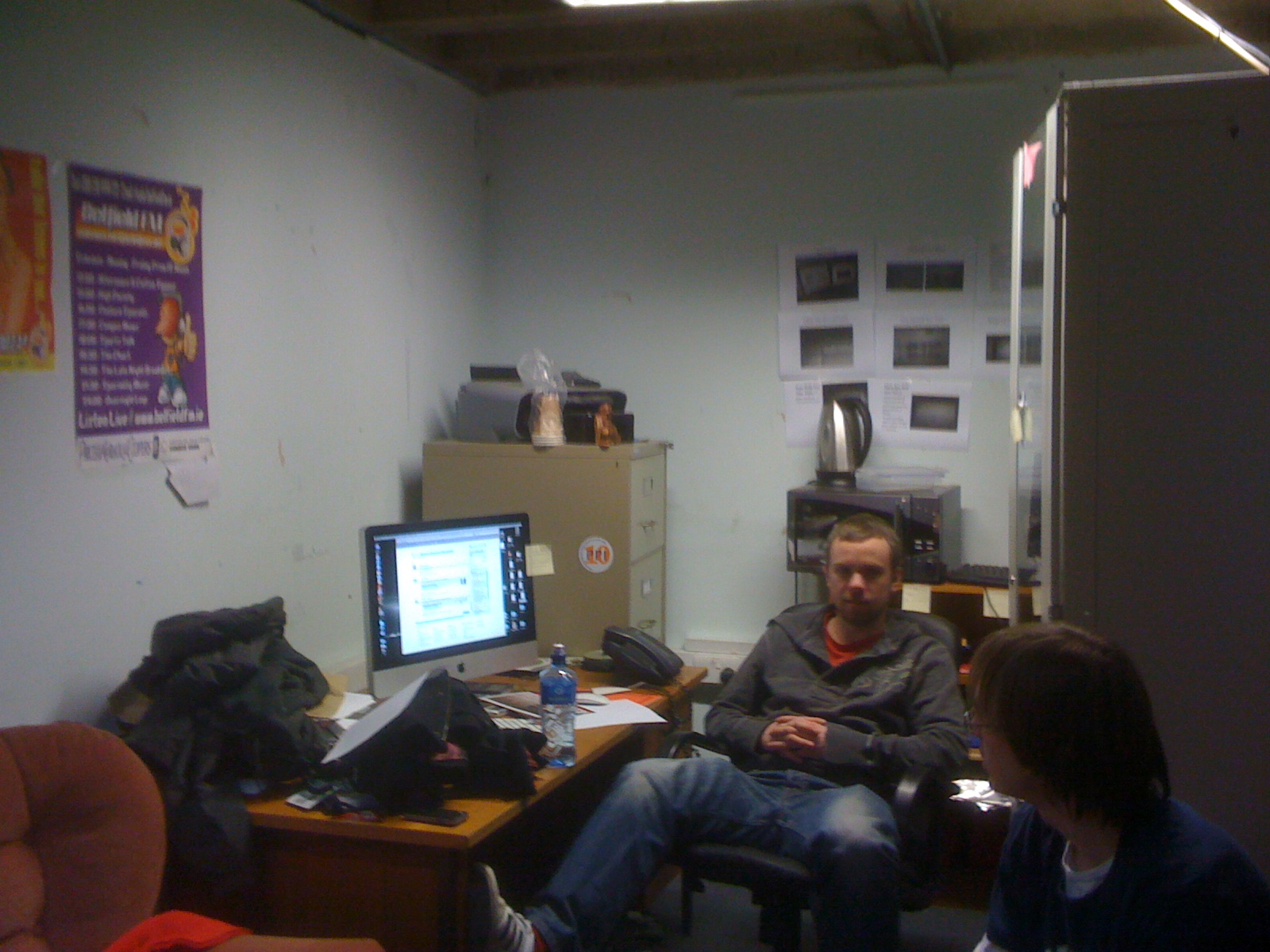
Wednesday, April 11, 2012

Radio Station Field Trip 30 - KCNL, KSJO, and KLOK in San Jose

Outside KLOK, KCNL, KSJO headquarters in San Jose
(All photos by Jennifer Waits)

Back in February I received an email with an intriguing offer of internships for college students interested in working in radio. The attached flyer stated,  

"Hey radio junkies! Want to host your own radio show? Buzz Radio FM is looking for new DJ’s in San Jose! No experience needed. Pick and choose your own style of music, program, and/or show. Reserve your preferred time slot NOW! For as little as $30 per hour!" 

It turned out that the station, Buzz FM, was affiliated with commercial radio station KCNL 104.9 FM in San Jose. With my curiosity piqued by this offer, I scheduled a visit to KCNL to learn more about their radio operations and to find out how college radio DJs could get on the air at their station. 


On the afternoon of February 21, 2012, I trekked down to the San Jose headquarters for commercial radio station KCNL and its sister stations KLOK and KSJO. The non-nondescript mid-20th century building housing the stations is located in the historic KLOK building in southeast San Jose. Adjacent to the building is a large field containing radio equipment, satellite dishes, and towers, with a view of the nearby foothills. 


A 25th anniversary plaque from 1971 at the entrance to the building reads, "On October 13, 1946 E.L. Barker, founder of KLOK radio began his 'birth of a station.' The first broadcast on 1170 KCS was with a 5kw signal for daytime only." According to the plaque, Barker sold KLOK to Davis Broadcasting in 1967 and in 1969, "KLOK radio became the most powerful standard broadcasting station in the entire Santa Clara County with a signal increase to 50kw daytime."


Today, KCNL, KLOK (still at 1170 AM), and KSJO (92.3 FM) are owned by Principle Broadcasting Network, a "portfolio holding company" for Mercury Capital Partners. Principle bought these three stations between 2009 and 2011 and according to the Mercury Capital Partners website, the stations are run using a "ethnic brokered time business model." Through this model, they lease out airtime to "various ethnic groups who have traditionally been disenfranchised from gaining access to the kinds of mainstream media broadcast properties which Principle owns." Currently they lease airtime on KCNL to the Hispanic community, rent airtime on KSJO to the Chinese community, and sell airtime on KLOK to the Asian Indian community.

Buzz FM Studio at KCNL
(Photo: J. Waits)

In addition to leasing airtime over traditional FM and AM airwaves, Principle has also been establishing separate radio brands on various HD channels. As it turns out, Buzz FM, which initially had led me to visit KCNL, is a new project over KCNL 104.9 FM's HD3 channel. While Buzz FM awaits programmers, its HD channel and website currently airs a mix of automated music ranging from the Beatles to the Cure to Johnny Cash. 

When I visited in February, I was told that it was a brand new project that had only really started two weeks before I stopped by. At that point it hadn't been promoted or marketed and its sole program was hosted by a member of their station staff. That show, "The Weekend Show" aired on Sunday nights beginning back in December, 2011 and by mid-February there had been 8 episodes of the male-oriented talk show. When I checked this week, the Weekend Show website was no longer available. 

In addition to Buzz FM, KCNL also utilizes a second HD channel, HD2, for S*ALT (aka Save Alternative). This alternative rock format also airs over KCNL's regular 104.9 FM signal on Saturday and Sunday nights and is available online 24/7. Prior to the launch of Chinese programming on KSJO, Save Alternative briefly aired over 92.3 FM. 

Messages from KCNL Guests and Hosts in Hallway at Station
(Photo: J. Waits)

The remainder of the KCNL schedule, under the brand iFM, is made up of Spanish language talk shows and music programming, including bilingual alternative rock. According to Principle's Local Sales Manager Manuel Rojas, "the community" is on the air at KCNL, including "the guy next door and his business." Brokered shows on KCNL include a range of programs including specific shows focused on health, religion, and music.


In terms of the current programming on KSJO 92.3 FM goes, it's comprised of brokered Chinese language programming over the regular FM channel under the brand China 92.3 FM. The format change to Chinese-language programming began in 2011 after Principle purchased KSJO from Clear Channel. The schedule today is made up of talk (including one show hosted by a man who one DJ at KSJO characterized as the "Larry King of the Chinese community"), music, news, and entertainment shows in Cantonese and Mandarin. During periods when the airwaves are not leased out, they play a mix of automated Chinese music programming. 


On KSJO's HD2 channel they broadcast technology-themed talk shows and techno music under the brand 24/7 Tech Radio. A message on the KSJO website also invites interested parties to get involved with the new channel, stating, "Universal Media Access is in the process of developing a 24/7 Tech Channel. If you are interested in being part of this project, send us an e-mail..." Not much content is available on the 24/7 Tech Channel website, but 4 episodes of September broadcasts of the program "Tracking the Tech Revolution," are available to listeners. It's unclear from the schedule if there are regular talk shows airing right now.


Principle's purchase of KLOK from Univision was completed in 2009. Today the 50,000 watt AM station broadcasts Asian Indian brokered programming under the brand Desi 1170 after launching with an all-music format. Shows range from talk shows hosted by members of the community (including shows dealing with law, mortgages, wellness, and money management), a Christian show, and a range of programs from the entertainment network Radio De' Hotties. When there isn't a live or brokered show, KLOK plays contemporary Indian music across a variety of genres. Desi 1170 is also simulcast into New York City.


As I toured around the offices for each station, I also noticed some of the things that were missing. There is no physical music library at any of the stations, although I was told that Principle did acquire some vinyl records from Clear Channel as part of their purchase. That material is in storage. DJs at various stations do bring in physical music from time to time, but Rojas said that it is mostly used as background music since the traditional AM and FM stations are mostly talk. I did see CD players and even a turntable (at Buzz FM), so DJs and hosts certainly do have the ability to play physical music if they desire.


Less than 6 weeks after my visit, word came out that Principle would be selling KCNL to University of Southern California (USC) for use in their network of classical radio stations as another outlet for broadcasting KDFC (which currently airs over the former college radio station KUSF as well as over 2 additional signals in the North and South Bay Area). In light of this pending station ownership transfer, the future KCNL's HD programs (Buzz FM and Save Alternative) is a bit unclear at the moment.

According to Brad Behnke, COO of Principle, Save Alternative (S*ALT) "will continue as an Internet operation." He told me that they are "still studying Buzz" to see if it will continue online or over another HD channel. In any event, the brokered Spanish language programming on KCNL will end by the time that the FCC approves the license transfer, if not sooner. 

Although a local marketing agreement (which would allow USC to rent the KCNL airwaves in advance of FCC approval of the license transfer) was included with the FCC paperwork regarding the sale, Behnke says that the timing of the beginning of classical programming over KCNL "depends on when the FCC grants the license transfer." When I asked Brenda Barnes, President of USC Radio, about the timing of the start of classical music programming over KCNL she said, "We haven't determined that yet." As far as whether or not this sale might have implications for Principle's other properties of KLOK and KSJO, Behnke said, "remains to be seen."


In the weeks to come we will probably learn more about what the future holds for KCNL and its related brands in light of its pending sale to USC. I feel lucky to have gotten the chance to visit this commercial radio station group in advance of these upcoming changes. Thanks to Rojas and everyone else at Principle for giving me a glimpse into their intriguing group of commercial radio stations.


See a complete list of all of my Spinning Indie Radio Station Field Trips here.

Monday, February 13, 2012

Radio Station Field Trip 29 - Trinity FM at Trinity College Dublin

View out the Window at Trinity FM

Last month when I was visiting Ireland I managed to visit two student radio stations near Dublin. My first stop was Belfield FM, which I profiled a few weeks back. My next visit was to the Trinity College radio station in Dublin, known simply as Trinity FM.


I headed over to Trinity FM on the afternoon of Tuesday, January 17, 2012. Located near the entrance to the college, the station was on the top floor of House 6, a historic campus building that contains a number of offices, including a book shop and the communications office. Trinity College itself is more than 400 years old and the campus features beautiful old buildings surrounding a central area full of walking paths and green spaces. Despite the age of the university, the radio station is relatively new and first started as a temporary station around 1998 in order to cover the "Trinity Ball," a massive annual music party held on campus to celebrate the end of each academic year. The station was such a hit that they decided to keep it going.

Trinity College Dublin. Trinity FM is Located on the Top Floor

Run entirely by student volunteers, Trinity FM operates out of a small space up several flights of stairs in House 6. When I visited they hadn't yet resumed broadcasting for the semester, but were set to start webcasting from 5pm to midnight beginning on January 30th. As is the case with many student stations in Ireland, Trinity has a special radio license that allows them to broadcast over FM for a specific number of weeks every year. This year they are approved for 6 weeks of terrestrial broadcasts, which will air from 9am to midnight during 6 pre-arranged weeks throughout the year over 97.3 FM. The first FM week this semester will be the week of February 20 to 24.

An old Schedule for Trinity FM

Trinity FM's Station Manager Matthew Taylor toured me around the station and filled me in on the inner-workings of the station. Taylor said that there is a great amount of interest in the student radio station, with 300 people signing up to join Trinity FM during Freshers Week (the week before classes start). He said that about 100 students are active at the station, with a core group of 20 to 30 volunteers. Students who sign up to volunteer at Trinity have the opportunity to apply for regular streaming shows, which pretty much air for the entire year. Approximately 60% of the streaming shows are music shows and 40% are talk programs.

Trinity FM Station Manager Matthew Taylor in the Studio

FM shows work a little differently and the application process is much more competitive. An editorial board selects programs for FM across a number of specific categories, including news/current events, culture, Irish, light entertainment, film, European affairs, and music. Taylor said that the FM slots fill up quickly, as editors match applicants with available time slots. During the weeks when FM broadcasts occur, the regular streaming shows go on hiatus.


In terms of content, shows on Trinity FM include the live music show Reverb, which features local bands, the popular long-running (it's in its 7th year) Plastic Soul show which is hosted by a Drama lecturer from Texas, and a vinyl-focused show called Wax Poetics. Over the years there have also been a number of shows hosted by international students from Russia, the United States, and South Africa. Schedule updates can be found on Trinity FM's twitter feed and on its Facebook group.


Taylor said that DJs have a lot of freedom to do what they'd like on their shows as long as they are respectful of the rules. Hosts are asked to limit swearing before 8pm and to not air anything libelous. They also aren't allowed to smoke or drink in the studio so as to ensure that equipment isn't damaged. Taylor mentioned that many years ago a DJ was kicked off the air after for a foul-mouthed show about bondage. He said that when the show was initially awarded the DJ was vague about the concept of the show, so it ended up being a surprise to the staff when he went on air. He added that they do listen and check in on FM shows in particular for appropriateness, especially after that incident. Streaming content has a little more freedom and isn't as regulated as terrestrial radio in Ireland.


They've opted to divide the 6 weeks allotted for FM broadcasts across the academic year so that terrestrial broadcasts occur for the most part during the last week of every month. The frequency of 97.3 is actually shared across a number of broadcasters, which is part of the reason why they are only licensed to use it for a certain number of weeks every year. The FM signal only reaches about 2 miles, so for the most part Trinity FM is only heard on campus.

Trinity FM Office

The small Trinity FM space includes an office and the broadcast studio. Since it's in a historic building they have some limitations on what they can do with the space and because of that they are unable to do extensive soundproofing. For that reason they have to make sure that people in the office aren't too loud when a DJ is on the air in the adjacent studio. Additionally, because the historic structure can't be upgraded to be wheelchair accessible, Trinity FM is unable to apply for some community funding that is contingent upon having a more accessible station. There was some talk that they might be about to move to a Student Center in a different building, but those plans were squashed when a Student Center referendum failed to gain enough votes.

Trinity FM Studio (Notice the Old Fireplace in the Background)

For the most part DJs bring their own music to Trinity FM, with some opting to bring CDs and vinyl, but many just use You Tube or play music from their laptops. While I was touring the station, one DJ popped in and mentioned that he'd been sent a red transparent vinyl record and he spoke of it as if it was a novelty, so it would seem that vinyl is only sparingly played there despite the availability of turntables. They have a 45 gig library of digital music available for DJs to play, but there isn't much in the way of a physical library. A CD library does exist, but it was in a locked cupboard when I visited. I was told that DJs play an eclectic mix of music including indie, folk, reggae and live music.


In addition to their on-air work, Trinity FM also brings events and lectures to Trinity College, including a series of talks presented by professional DJs who have shared stories about working in radio. One station volunteer is working on a graduate project related to radio journalism and someone else from Trinity FM did her dissertation on the topic of radio and society. The station has also put on a number of concerts on campus, including a recent one in a chapel and another in a gothic building. One ambitious event, the Hallow Sessions, was a mini acoustic music festival.


As I toured the station I was also impressed to see their painted wooden signage. I was told that due to the inclement, often windy and rainy weather in Ireland, regular banners often blow away at events. Because of that, they have built big wooden signs that they haul out for campus events like Freshers Week (the week before classes start).


Taylor said that he's really enjoyed his time at Trinity FM and mentioned that he's gotten close to many people through his work there. He used to do a news and public affairs show and has attended conferences in Brussels on behalf of the station. He said, "Being on the radio is really fun."

Thanks so much to Matthew Taylor and everyone else at Trinity FM for giving me the grand tour.


Previous Spinning Indie Radio Station Field Trips:

Field Trip to WECB at Emerson College
College Radio Field Trip 2 - Cal Poly's KCPR
College Radio Field Trip 3 - Notre Dame's WVFI
Radio Station Field Trip 4 - WFMU in Jersey City
Radio Station Field Trip 5 - East Village Radio in NYC
Radio Station Field Trip 6 - WNYU in New York City
Radio Station Field Trip 7 - Northwestern's WNUR
Radio Station Field Trip 8 - Stanford's KZSU
Radio Station Field Trip 9 - University of San Francisco's KUSF
Radio Station Field Trip 10 - Santa Clara University Station KSCU
Radio Station Field Trip 11 - UC Berkeley's KALX
Radio Station Field Trip 12 - KSJS at San Jose State University
Radio Station Field Trip 13 - WBAR at Barnard College
Radio Station Field Trip 14 - KFJC at Foothill College
Radio Station Field Trip 15 - UC Santa Cruz Station KZSC
Radio Station Field Trip 16 - Haverford College Station WHRC
Radio Station Field Trip 17 - FCCFree Radio in San Francisco
Radio Station Field Trip 18 - Flirt FM in Galway, Ireland
Radio Station Field Trip 19 - RXP 101.9 FM in New York City
Radio Station Field Trip 20- WGBK at Glenbrook South High School
Radio Station Field Trip 21 - KPDO in Pescadero, California 
Radio Station Field Trip 22 - KZYX in Philo, California 
Radio Station Field Trip 23 - San Francisco's Pirate Cat Radio
Radio Station Field Trip 10.5 - KSCU's New Digs at Santa Clara University (2010)
Radio Station Field Trip 24 - Radio Valencia in San Francisco
Radio Station Field Trip 25 - WZBC at Boston College
Radio Station Field Trip 26 - KSFS at San Francisco State University 

Wednesday, January 25, 2012

Radio Station Field Trip 28 - Belfield FM at University College Dublin

When I was out of the country during the past few weeks, I couldn't resist the opportunity to resume my Spinning Indie radio station field trip series by visiting a few student radio stations in Ireland. First up was Belfield FM, the student radio station at University College Dublin (UCD). Located just outside of Dublin in the town of Belfield, the station itself is hidden away on a corridor just off a tunnel adjacent to the James Joyce Library. During the 2011-2012 academic year the station is broadcasting on 107.8 FM and online.

 Belfield FM Office

An interesting thing about many student radio stations in Ireland is that some of them bounce around the FM dial and aren't on the same frequency from year to year. Each year certain stations apply for a frequency and last year Belfield FM was only on FM for a total of 4 weeks. The Broadcasting Authority of Ireland (BAI) is the regulatory agency that handles radio licensing in Ireland. The BAI allows for temporary radio licensing, which is why a number of stations operate for only a few weeks out of the year. A recent list of temporary sound broadcasting applications  (PDF) includes Belfield FM, which is licensed to broadcast Mondays through Fridays. Currently they broadcast from 1pm to 9pm from a transmitter atop their campus building, although most of their listeners tune in online. Some other college radio stations in Ireland, including Spinning Indie field trip stop FlirtFM, are designated community/special interest broadcasters and broadcast on a more permanent basis.

Belfield FM Studio

Student radio has been a staple of UCD since 1990, although the name Belfield FM wasn't introduced until 2006. In the early days, they only broadcast terrestrially for 4 to 6 weeks out of the year and the station shut down for several years before relaunching. Since 2008 the station has been in its current location, but it's scheduled to move to a new Student Center on campus in September. Its new studio in the Student Center has already been built and they should have access to it by April. They will continue to use the current studio as a production studio so that DJs will have the ability to pre-record their shows.


I visited Belfield FM on the afternoon of Monday, January 16, 2011, which was the first day of broadcasts for the new semester. Although I knew the general location of the station, I still had a difficult time finding it since the door to the station only contained a tiny handwritten sign on a ripped scrap of paper reading "Belfield FM." The volunteers who I met with told me that every year the station is a stop of a campus "treasure hunt" and acknowledged that they should probably make a bigger sign.

Belfield FM's small space contains an office with a couch, desk, and broadcasting equipment as well as an adjacent studio. Although the surroundings are spartan, the station has around 80 volunteers including approximately 50 regular participants.

 Checking out the lack of signage of the door to Belfield FM

When I visited, 4 DJs were hanging around the office and it was fun hearing their stories about the station. Station Manager Peter Branigan toured me around the station and was joined by the Executive Producer of BeatsanPieces Dylan Gray, Assistant Manager Oisín Boyce, and Assistant Manager Darragh O'Connor. They all pointed out the great sense of community that they've felt at Belfield FM and mentioned that they've met many of their close friends through the station. They also mentioned that many students on campus are interested in coming in to the station and that they frequently have friends asking them about radio.


The station isn't connected to an academic department at UCD, instead existing as a student club that is funded by the Student's Union and student fees. DJs have a lot of freedom and there are a range of shows on-air, from music shows, to talk shows, to sports programs. There aren't too many restrictions other than not swearing (they told me that there are 5 dirty words in Ireland) or defaming anyone over the air. DJs keep track of their playlists on paper, but those lists aren't used for any sort of charting.

Paper Playlist

Although there isn't much in the way of a music library other than a small drawer full of CDs, most of their material has been digitized and Belfield FM has a digital music library containing nearly 16,000 tracks. Most DJs bring their own music and frequently play material and music off of You Tube. CD players are also available for DJs to use, but there are no turntables or tape decks in the studio.

CD Drawer

Live bands also come to play at Belfield FM, particularly on the "Unsigned and Underrated" show. There's also an "International Music Show," on Friday nights at 5:30pm, "School of Heavy Metal Studies" program on Wednesday nights at 5:30pm, and an "Electro Show." Darragh O'Connor also hosts the "Wrestleview International Desk" program which delves into the world of wrestling.


Belfield FM has also produced a number of live broadcasts, including sabbatical debates, which they broadcast from a nearby campus theater by running wires from their studio. They just got funding to purchase an outside broadcast unit, so the station is hopeful that it can air more live events, including sports commentary.

Belfield FM Broadcast Bible

I'm always interested in the nitty gritty details about a station's operations, so I was excited to grab a copy of the Belfield FM Broadcasting Bible from 2009-2010 (a copy of which can also be found on their website, along with other materials for volunteers). According to the Broadcasting Bible, "We want to provide the students of UCD with an accessible forum for information, debate and concerns relevant to all aspects of student life, and to create an awareness of the student community among the wider population of the city."

Thanks to everyone at Belfield FM for showing me around your fine station! Stay tuned, my next stop in the Spinning Indie field trip series will be to another student radio station in Ireland.


Previous Spinning Indie Radio Station Field Trips:

Field Trip to WECB at Emerson College
College Radio Field Trip 2 - Cal Poly's KCPR
College Radio Field Trip 3 - Notre Dame's WVFI
Radio Station Field Trip 4 - WFMU in Jersey City
Radio Station Field Trip 5 - East Village Radio in NYC
Radio Station Field Trip 6 - WNYU in New York City
Radio Station Field Trip 7 - Northwestern's WNUR
Radio Station Field Trip 8 - Stanford's KZSU
Radio Station Field Trip 9 - University of San Francisco's KUSF
Radio Station Field Trip 10 - Santa Clara University Station KSCU
Radio Station Field Trip 11 - UC Berkeley's KALX
Radio Station Field Trip 12 - KSJS at San Jose State University
Radio Station Field Trip 13 - WBAR at Barnard College
Radio Station Field Trip 14 - KFJC at Foothill College
Radio Station Field Trip 15 - UC Santa Cruz Station KZSC
Radio Station Field Trip 16 - Haverford College Station WHRC
Radio Station Field Trip 17 - FCCFree Radio in San Francisco
Radio Station Field Trip 18 - Flirt FM in Galway, Ireland
Radio Station Field Trip 19 - RXP 101.9 FM in New York City
Radio Station Field Trip 20- WGBK at Glenbrook South High School
Radio Station Field Trip 21 - KPDO in Pescadero, California 
Radio Station Field Trip 22 - KZYX in Philo, California 
Radio Station Field Trip 23 - San Francisco's Pirate Cat Radio
Radio Station Field Trip 10.5 - KSCU's New Digs at Santa Clara University (2010)
Radio Station Field Trip 24 - Radio Valencia in San Francisco
Radio Station Field Trip 25 - WZBC at Boston College

Tuesday, January 17, 2012

Save KUSF Protest Marks One Year Anniversary of KUSF Shutdown

It's hard to believe that it's already been a year since KUSF was taken off the air by officials at University of San Francisco. 2011 was marked by a year of protests and actions by KUSF supporters, as well as by the launch of KUSF in Exile in order to keep the spirit of KUSF alive. Tomorrow, in honor of the anniversary of the shutdown, there will be a protest at 10am (the time that KUSF turned to static on January 18, 2011) at Entercom headquarters in San Francisco. The programming now airing over KUSF's 90.3 FM signal (classical station KDFC) is originating from Entercom headquarters. KDFC (now owned by Classical Public Radio Network) used to be a commercial classical station owned by Entercom.

The January 18, 2012 protest will take place from 10 to 11am at 201 Third Street (at Howard). Later that evening, there will be an after-party at WIX Lounge (3169 22nd Street, between Capp and Mission in San Francisco) featuring guest speakers and KUSF in Exile DJs spinning records.

Monday, May 16, 2011

Radio Station Field Trip 27 - KEAR and Family Radio in Oakland, CA

KEAR offices on May 12, 2011 
(All photos by J. Waits)

When I started my radio station field trip series I had intended to focus solely on college radio stations, but I pretty quickly made some exceptions when I ran across interesting commercial and community radio stations. Last week, I took an even greater detour when I decided that I needed to visit Christian radio station KEAR-AM, which is at the helm of the Family Radio network of religious stations. After hearing a Family Radio broadcast I became intrigued by its General Manager's proclamation that May 21, 2011 would be Judgment Day and that October 21, 2011 would mark the end of the world. When I first heard Family Radio General Manager Harold Camping over the airwaves a few weeks ago, I had no idea that his station was based in Oakland, California. When I realized that it was so near by, I knew that I had to tour before the predicted Armageddon.

One of Harold Camping's books in the Family Radio offices on May 12, 2011
(Photo: J. Waits)

So, on Thursday, May 12, 2011, I ventured out to Family Radio headquarters in order to tour the station, interview Harold Camping, and learn more about the inner-workings of the massive Christian radio network (see Radio Survivor for my full report on Camping's take on Judgment Day). I began my visit by attending a taping of a Harold Camping-led "Family Bible Study," which was being recorded for television and radio. As a studio audience and camera crews from Nightline and Univision watched, Camping flipped through Bible passages and talked about the nearness of Judgment Day.

Although Family Radio began in 1958 with one radio station (KEAR-FM at the time in San Francisco), it has since expanded to 60+ radio stations across the United States, 50+ translators, a shortwave station in Florida, and television stations in San Francisco and New York. Programming originates out of their Oakland headquarters, with operators in their Network Control department monitoring the patchwork quilt of signals 24 hours a day.

Family Radio President and General Manager Harold Camping in His Office on May 12, 2011
(Photo: J. Waits)

Harold Camping was one of the founders of the network in 1958 when he worked with a group of people to purchase KEAR-FM in San Francisco. When I interviewed him last Thursday, May 12, 2011, he told me that didn't have an interest in radio before that time. He graduated from University of California, Berkeley with a degree in engineering and had a career in the construction business. When I spoke with Camping, he relayed to me the beginnings of Family Radio:


Jennifer Waits: So you were saying you had no interest in radio before?

Harold Camping: Right. That was not my interest. I was interested in dairy cattle and I was interested in math and interested in physics and science, but not radio.

Jennifer: What got you thinking about starting up a radio network?

Mr. Camping: Someone came to my office...and he wanted to find some Christian businessmen to buy a radio station and share the gospel. And, oh, to share the gospel, that's what got my interest. So, I agreed that provided we have a non-profit corporation so that nobody could ever realize any gains for themselves. And so, we formed a non-profit corporation called Family Stations, Incorporated. I became President and he became Vice-President. I had another young man working for me and we made him the third member to be legally a qualified corporation. And I put this man on my payroll...and he found a station here in San Francisco and we bought it and that was the beginning of Family Radio.


Jennifer: And what do you now love about radio?

Mr. Camping: I've been enmeshed in it for 52 years. I've been able to supervise the construction of radio and supervise the construction of TV. We built a 350 kilowatt station in Taiwan and a 600 kilowatt station in Taiwan to carry our programming to China and to the Philippines and so on.


Jennifer: So, you've been doing Open Forum for 50 years. How did that show start?

Mr. Camping: That started because at that time we were not getting any help from any churches and although we had paid very little to whatever employees we had, we were running out of money. So we had the idea that if I would be behind the mic as President and answer questions about finances or about music policy, that might encourage people to begin to give. So, we opened the telephone lines and I did my first program and they didn't ask any questions about finances or music, but they asked counseling questions and Bible questions. And I found that I enjoyed that very much and I was somewhat qualified because I had been doing quite a bit of study in the Bible and doing some private counseling. And so that began Open Forum.


It's clear when walking through Family Radio headquarters that the company is much more than a network of radio stations. They have their own print shop, which produces books and literature related to their beliefs. The Internet department maintains the website and creates Family Radio ads for placement on Facebook, Google and Microsoft websites.

KEAR-AM Studio in Oakland on May 12, 2011
(Photo: J. Waits)

Family Radio airs a mix of programming, including the popular live call-in show "Open Forum" (which has been on the air for 50 years) hosted by Camping 7 nights a week (it was 5 nights a week until a few weeks ago), children's programming, programs on "Positive Parenting," shows about Creationism and intelligent design, religious music shows, and the other live show, "Prayer Time," which broadcasts prayer requests from listeners (ranging from someone's desire for "a new transmission" to requests for prayers for cancer-stricken relatives). Most programmers and producers at Family Radio craft their shows remotely, so when I visited I didn't get the opportunity to see any live programming in action. I did see a producer working in one of the 8 control rooms and got the opportunity to check out the set up.

A portion of the vinyl library at Family Radio
(Photo: J. Waits)

The walls outside the production studios were filled with long-forgotten vinyl LPs that are no longer played. Although I saw numerous turntables, apparently vinyl records are now a relic at Family Radio after an archiving project a decade ago paved the way for the digital library of about 8000 pieces of music that is currently in use today. Beyond the vinyl LPs that I spotted outside the studios, in a Music Department office, and in a packed-to-the-gills closet, there's apparently more music housed in an off-site storage facility. In addition to the music shows that air today, Family Radio used to have a classical show on Sundays.


The music in Family Radio's digital archive is categorized across a number of different types of music, including organ, piano, orchestra, instrumental, male solo, female solo, choirs, male chorus, duets, trios, and quartets. I was told by a member of the Music Department that all music is carefully screened by several different reviewers on staff. In addition to screening music for its lyrical content to verify its take on the gospel and theology, the staff also ensure that music adheres to Family Radio's overall air sound, which was described to me as being "traditional" and "more of the hymn type" style of sacred music. A Family Radio staff member told me, "we don't have drums" or "anything with a beat," although she acknowledged that "it can be a little upbeat...but not loud percussion." And, as I listened to the station today, I did hear a slightly upbeat song with male harmonizing vocals that reminded me of the Beach Boys. So, it's true that they do mix it up a bit musically.

Closet at Family Radio Chock Full of Vinyl and CDs
(Photo: J. Waits)

Although listeners often call the network to ask about music that's been played, it's not Family Radio's policy to announce artist names over the airwaves. They will gladly provide that information to callers, but I was told that as a rule, "we don't promote people" over the air, which means that they don't do on-air back announces of the pieces that have been played. For the most part the music that they play is old, as evidenced by some of the titles that I spotted in their vinyl library. The old-fashioned music that I heard while listening to Family Radio on several occasions was actually kind of alluring in that it was so vintage. In that respect, it did sound like nothing else on radio and brought to mind my own memories of my grandparents glued to broadcasts of the Lawrence Welk show. Oddly enough, one of the albums that I saw on my visit featured Norma Zimmer, the "Champagne Lady" from the Lawrence Welk show. Stranger still, unbeknownst to me, Norma Zimmer died 2 days before my visit and her album happened to catch my attention while I was scanning through the record library at Family Radio. I hope that's not a sign...

Norma Zimmer LP at Family Radio
When I took this photo I had no idea that she had died 2 days before!
(Photo: J. Waits)

To learn more about Family Radio's take on Judgment Day, see my article on Radio Survivor, which also includes more from my interview with Family Radio's General Manager Harold Camping.

Equipment in Network Control at Family Radio
(Photo: J. Waits)

Previous Spinning Indie Radio Station Field Trips:

Field Trip to WECB at Emerson College
College Radio Field Trip 2 - Cal Poly's KCPR
College Radio Field Trip 3 - Notre Dame's WVFI
Radio Station Field Trip 4 - WFMU in Jersey City
Radio Station Field Trip 5 - East Village Radio in NYC
Radio Station Field Trip 6 - WNYU in New York City
Radio Station Field Trip 7 - Northwestern's WNUR
Radio Station Field Trip 8 - Stanford's KZSU
Radio Station Field Trip 9 - University of San Francisco's KUSF
Radio Station Field Trip 10 - Santa Clara University Station KSCU
Radio Station Field Trip 11 - UC Berkeley's KALX
Radio Station Field Trip 12 - KSJS at San Jose State University
Radio Station Field Trip 13 - WBAR at Barnard College
Radio Station Field Trip 14 - KFJC at Foothill College
Radio Station Field Trip 15 - UC Santa Cruz Station KZSC
Radio Station Field Trip 16 - Haverford College Station WHRC
Radio Station Field Trip 17 - FCCFree Radio in San Francisco
Radio Station Field Trip 18 - Flirt FM in Galway, Ireland
Radio Station Field Trip 19 - RXP 101.9 FM in New York City
Radio Station Field Trip 20- WGBK at Glenbrook South High School
Radio Station Field Trip 21 - KPDO in Pescadero, California 
Radio Station Field Trip 22 - KZYX in Philo, California 
Radio Station Field Trip 23 - San Francisco's Pirate Cat Radio
Radio Station Field Trip 10.5 - KSCU's New Digs at Santa Clara University (2010)
Radio Station Field Trip 24 - Radio Valencia in San Francisco

Friday, May 13, 2011

Radio Station Field Trip 26 - KSFS at San Francisco State University

View from KSFS Production Studio into Station Lobby
(Photo by J. Waits)

After the events of January 18, I kind of went into an obsessive spiral, fixating on every last detail of the unfortunate situation at University of San Francisco's college radio station KUSF. I find it tragic that the only terrestrial college radio station in San Francisco's city limits was yanked from the air by the university in order to beef up its cash reserves. Yet, I also tried to remind people that KUSF was actually not the ONLY college radio station in San Francisco. San Francisco State University has a long tradition of college radio, which continues to this day with its online-only station KSFS.

On November 19, 2010, I accepted an invitation to sit it on a friend's show at KSFS and was excited to get a chance to check out the station. A few weeks later I sat down with KSFS advisor Jeff Jacoby to learn more about the station and also chatted by phone with former KSFS advisor Rick Houlberg. After touring the station and attempting to research its history, I became frustrated by the lack of information about the 50+ year old station and then got distracted by reporting on the KUSF saga.

So, here is my much belated field trip report from KSFS, along with a plea for an interested broadcasting historian to take up the challenge to compile a proper history of the station, as I'm sure it's fascinating.

KSFS DJ Nick Carpenter

Before visiting KSFS, all that I really knew of the station was that music journalist and radio fan Ben Fong-Torres had been a DJ there back in the 1960s and that Real World Seattle alum Irene McGee got some attention for her radio show there around 2005. But the station's history goes back much further. From what I've been able to ascertain from my limited research, the Radio Department was founded at San Francisco State College around 1946 and it's possible that a campus radio station began in the late 1940s or early 1950s. According to Rick Houlberg (who joined the station as its advisor in 1982), in the early days of the station, then known as KRTG (for "radio television guild"), broadcasts were from a pre-fab Quonset hut structure utilizing 2 loudspeakers. By the early 1960s the Creative Arts building was constructed on campus and the Radio Department and station were given a permanent home.

Lobby of KSFS
(Photo: J. Waits)

Ben Fong-Torres remembers being at KRTG around 1965 or so. He told me that at the time the station switched formats from being a mix of jazz, folk, spoken word, and educational material to a Top 40 music station. He said that there were basically no listeners, although the station was piped in to the dorms. Ben described a phone receiver-like device that was in each dorm room and told me that one had to dial it to 880 to listen to the station over 880 AM.

Radio Sign on Creative Arts Building at San Francisco State University
(Photo: J. Waits)

Today, KSFS is still housed in the basement of the Creative Arts building. Although KSFS was never a licensed station, it did broadcast into dorms and campus buildings through a carrier current system (as described by Ben). Eventually it got hooked into the campus cable system before going online-only. Rick told me that there's a rumor that in the late 1960s or early 1970s KSFS had a chance to obtain an FCC license after a commercial radio station offered to sell its entire station, from microphones to transmitter, to San Francisco State for $1. San Francisco State turned down the offer, apparently fearful of giving the students a larger broadcast platform.

Rick told me that KSFS eventually had a small transmitter (less than 1 watt) and an antenna on top of the library. A line was run from the antenna to KSFS in the Creative Arts Building. The transmission on campus was so weak, that one could only hear it within the line of sight of the antenna at 88.1 FM. Because of fears of complaints about interference from local stations (namely public radio station KQED) and local residents, the station was never able to get more powerful than 1 watt.  One of the main ways that students on campus used to listen to KSFS was through the university's television cable system. Additionally, KSFS had its signal broadcast within San Francisco over cable television.

KSFS Studio
(Photo J. Waits)

One of the most interesting stories that I came across was in a history of San Francisco State written by Meredith Eliassen. She recounts a story that took place in 1966 involving Ken Kesey,

"Kesey, flanked with bodyguards from the Hells Angels, performed an 'acid test' in the studios of the campus radio station KRTG. The event aired to listeners in the Commons, in the Redwood Room, outside through speakers, and to the KRTG audience in the dormitories."

Rick told me that he'd never heard this story, but that it was "entirely possible" and said that at the time the university thought the station was "subversive" and that the school "did not want people to know that students had a voice."

Window to KSFS Studio
(Photo J. Waits)

Eventually, due to a number of factors, including construction on campus and lack of listeners, the low power FM broadcasts ceased after the antenna was removed from the library in 2008. A 2004 student newspaper account described the station's lack of a signal:

"The only way you could pick up a clear signal of the station's low broadcasting range is if your radio was no further than the sidewalk surrounding or steps leading up to the library."

Around the same time, though, KSFS was being broadcast in The Depot in the Student Center and was also broadcasting online.

KSFS Studio
(Photo: J. Waits)

Rick said that the station has functioned for more than 60 years as a "laboratory" for students interested in careers in broadcasting. In order to get on the air, one is required to be enrolled in a radio class at San Francisco State or be an alum.Having a live radio show is actually a requirement for the advanced radio class. Typically there are between 75 and 100 people involved with the station in a given semester and KSFS still seems to function as a training ground for radio and music industry hopefuls.

When I stopped by in December 2010, I chatted with the station's General Manager Tiffany Lintner. In addition to doing her show "Special Sundays" at KSFS, she was also working at commercial radio station KMEL as both an on-air host and a member of the promotions department. Her hip hop show at KSFS had over 900 followers on Twitter and she told me that she did have aspirations to be a commercial radio DJ. Last fall the KSFS Music Directors were also involved with commercial radio stations and labels.

Last fall the KSFS schedule featured live DJs from 8am to 11pm on weekdays and from 9am to 5pm on the weekends, with an automated loop of material filling in the slots without a live DJ. I was told that KSFS had just finished a project to digitize all of their CDs and that they were planning to get rid of the CDs. The station planned to hang on to its "large library" of vinyl records, however.

KSFS Vinyl Library
(Photo J. Waits)

Today, KSFS invites listeners to "Embrace the Chaos" as it broadcasts a mix of music and public affairs shows across its schedule. The current mission statement for KSFS reads:

"We provide cutting-edge, free-form radio with varied programming, including music, theater, talk, art, & information. The shows we stream seek to push the boundaries of what radio can be but are always focused on our listeners. KSFS serves as a training laboratory for students and as a radio station for the university, the City of San Francisco, and our worldwide Internet audience. We intend to be an integral part of the ongoing media (r)evolution and the myriad communities we serve and to offer a dynamic educational experience for the students of San Francisco State University."

Thanks to everyone at KSFS for sharing your station with me and for your patience in waiting for this report!


Previous Spinning Indie Radio Station Field Trips:

Field Trip to WECB at Emerson College
College Radio Field Trip 2 - Cal Poly's KCPR
College Radio Field Trip 3 - Notre Dame's WVFI
Radio Station Field Trip 4 - WFMU in Jersey City
Radio Station Field Trip 5 - East Village Radio in NYC
Radio Station Field Trip 6 - WNYU in New York City
Radio Station Field Trip 7 - Northwestern's WNUR
Radio Station Field Trip 8 - Stanford's KZSU
Radio Station Field Trip 9 - University of San Francisco's KUSF
Radio Station Field Trip 10 - Santa Clara University Station KSCU
Radio Station Field Trip 11 - UC Berkeley's KALX
Radio Station Field Trip 12 - KSJS at San Jose State University
Radio Station Field Trip 13 - WBAR at Barnard College
Radio Station Field Trip 14 - KFJC at Foothill College
Radio Station Field Trip 15 - UC Santa Cruz Station KZSC
Radio Station Field Trip 16 - Haverford College Station WHRC
Radio Station Field Trip 17 - FCCFree Radio in San Francisco
Radio Station Field Trip 18 - Flirt FM in Galway, Ireland
Radio Station Field Trip 19 - RXP 101.9 FM in New York City
Radio Station Field Trip 20- WGBK at Glenbrook South High School
Radio Station Field Trip 21 - KPDO in Pescadero, California 
Radio Station Field Trip 22 - KZYX in Philo, California 
Radio Station Field Trip 23 - San Francisco's Pirate Cat Radio
Radio Station Field Trip 10.5 - KSCU's New Digs at Santa Clara University (2010)
Radio Station Field Trip 24 - Radio Valencia in San Francisco